Favorite Quotes

==> Purpose: to inspire and uplift, encouraging readers to recognize their own creative potential through the stories of others. As John Cleese said: "Creativity is not a talent. It is a way of operating.”
Showing posts with label detroitartist. Show all posts

Monday, January 6, 2025

E17: Elise Martin - Intimacy, Empathy, and Care

Elise Martin

Shared Personal Space - Installation and Interaction.
All images are courtesy of the artist.


Elise Martin
I was born and raised in Metro Detroit and earned my BFA from the College for Creative Studies (2008-2012). Initially, I envisioned a career in painting or illustration, but my interests shifted and I became more engaged with sculpture, installations, and video art. My work often focuses on themes of intimacy, empathy, and care. I'm particularly drawn to soft materials and slow, hand-crafted processes because they naturally embody these themes. When I pursued my master’s degree at WSU (2020-2022), I chose to focus on fiber arts to deepen my understanding of the history and visual language inherent in these materials and techniques. My studio practice is complemented by my work in community arts and art education, which continually informs and enriches my creative work.


Elise - I'm so happy to have this time to chat about your work. Let's jump in!

------------------------------------

What do you love about making art?

I’ve reflected on this quite a bit—what first drew me to art, and what keeps me invested? It’s a combination of factors.

Firstly, I believe that art fosters community through acts of reciprocity. Much of my early art was created as gifts for people close to me, so art and hand-craft are forever tied to those gestures of care in my mind.

Secondly, there’s a rebellious aspect to art-making that I find deeply appealing. Beyond the freedom of expression, the act of creating, repairing, or mending something feels like a rebellion against the capitalist system. Making your own objects can be incredibly empowering, and this sentiment likely stems from my teenage punk rock DIY days. It’s also a reason I continue to teach art—to inspire moments of confidence in my students.

How do you evaluate your work?

It depends on the project. For more intimate works like paintings, textile collages or embroideries, the goal is often straightforward: to capture fleeting moments of connection or joy. I consider these pieces successful if they evoke similar feelings of happiness or nostalgia in others.

When I make large sculptural works or installations, I qualify them a lot differently. With those works, I might want to synthesize an experience and I’m focused on how the form and material will encourage that engagement. These works feel complete and successful only when they’ve been interacted with.

In both cases, I think the relationship between the work and its audience is key to evaluating the project’s success.
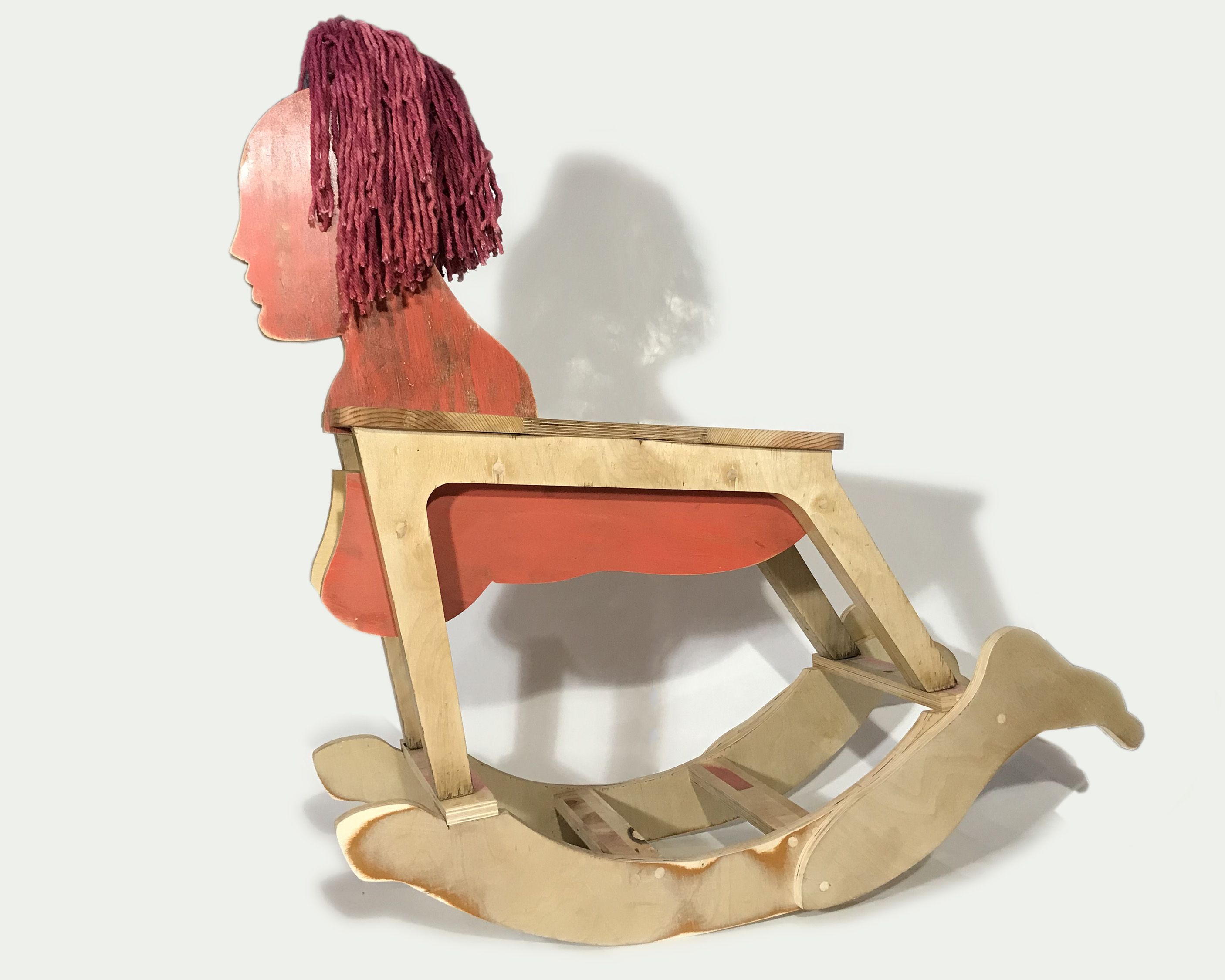
Child Care Worker- Self Portrait Rocking Toy

Where is your studio, and what is your primary work area?

Since 2015, I’ve been based at Fortress Studios, an artist-owned space in Detroit’s North End neighborhood. Initially, I came as an artist-in-residence for a year, but I never left.

We’re fortunate to have a metal shop, wood shop, and ceramics studio in the building, which I use as needed. However, my primary workspace is a fibers studio that I’ve set up in a section of my living space. It’s filled with racks of second-hand fabrics and yarns, and it houses my sewing machine and loom. I’m also known to take over our kitchen for basket-making, felting, or botanical dyeing. As I write this in the summer, much of my work has moved to the patio, where I can spread out to weave baskets or set up a small easel to paint watercolors in the open air.

"I use common materials and familiar forms, hoping to make my art accessible to a broad audience, not just those with an art background." - Elise

What clues or questions do you use to select an idea to invest time and resources?

I have a lot of ideas, and my practice can sometimes feel a bit scattered. However, certain nagging ideas will keep resurfacing, or something happens that reminds me of a previously conceived concept. Sometimes, clarity on a concept comes months or even years later, and that’s when I decide to pursue it.

Let Me Comfort You- Photo Story

About your work: what do you hope people notice the most?

I think the themes of my work—empathy, comfort, and care—are universal, so I strive to avoid intellectual barriers. I use common materials and familiar forms, hoping to make my art accessible to a broad audience, not just those with an art background. While it would be impossible to speak to everyone’s lived experience or account for all cultural differences, I try to use a visual language that will be approachable to others.  

How do you define success as a creative? How do you hold yourself accountable?

I focus less on the notion of being a “successful artist” and more on the success of individual projects. As a creative, I think you have to embrace the reality that many of your projects, proposals, and concepts might fail. The goal is then to appreciate the successes, learn from them and carry those lessons forward. As I mentioned before, much of my practice is deeply connected to relationships with others, so that naturally pushes me to keep sharing my work.

Tactile Memory No.1

When do you discuss things with your inner critic?

Constantly!

There was a meme that circulated years ago, and I think about it often. It said something like, “The Creative Process: 1. This is pretty good. 2. This is awesome! 3. This is tricky. 4. This sucks. I suck. 5. This might be okay. 6. This is awesome!”  I think that pretty aptly sums up just about every project I’ve ever worked on.

Who are your creative influences, and whose work are you admiring now?

As a child, my first “favorite artists” were Georgia O’Keeffe and Van Gogh; I think I enjoyed their use of color. In my teen years, I was more influenced by the dramatic gestures on punk album covers and the rebellious spirit of illustrators like Ralph Steadman. As an adult, I’m drawn to quieter, more subtle moments of weirdness. Artists like Louise Bourgeois, Kiki Smith, Hans Bellmer, Mike Kelley, and Janine Antoni have greatly influenced my sculptural and installation work. In terms of craft, I look to alot of art history and anthropology for inspiration, but I have a particular fondness for fiber artists linked to (or with lineage out of) the Bauhaus School, such as Gunta Stölzl, Anni Albers, and Ruth Asawa.

Tactile Memory No. 4

How can people follow you and your work?

You can find me at EliseMarieMartin.com or on Instagram at @Elise.m.art.in. The next opportunity to see my work in person will be at the opening of Womxn House Detroit 2024 on September 28th.

##

I can't thank you enough for taking time out of your schedule to talk with me/us, Elise. I'm cheering for you! Come back anytime you have something to share. 


+++++++++++++++++++++++++++++++++++++


Use Me - Small Arrangement View


Use Me Interaction 1


Tuesday, December 17, 2024

Y1 E15 - Elizabeth Wickerham - Teaching, Fibers, and Sourdough

Elizabeth Wickerham

All images courtesy of the artist

My name is Elizabeth Wickerham. I have been teaching art for seventeen years. I have taught grades 5th-12th. I am currently a teacher at New Lothrop Junior/Senior High School. I live in Flushing Michigan with my husband, two children, and lots of creatures. I have been making art since I could remember and I have always wanted to be a teacher so I combined my two passions. I have worked with so many mediums and I love clay, but more recently I have been working with fibers. More specifically needle punch. 


Hi Elizabeth - it's so great to have you here to talk with me/us. Let's jump in.


What do you love about making art?


Elizabeth Wickerham
My why has always been the satisfaction of making something with your hands. I think this has become so much more important than ever before. I have found that students struggle now more than ever with using their hands to create. Time spent on screens has really impacted their willingness to create. Instant gratification and the frustration at failing keep them from enjoying art. Once they get past these things, watching them love art like I do is another reason. That sense of accomplishment and pride are so important!! 

Where do you create?

I mostly work at home. I do love working with my students and when I have an advanced group I love working along with them. Working with others who love creating as much as I do is the most rewarding. 

How do you decide what to create?


When I invest time and money into a new project I like it to serve a purpose. Most everything I create has a place in my home or is created as a gift. I have really found joy in decorating and I often create chair pads, pillows, wall hangings, purses, rugs, and decorate around my creations. 


Do you have any advice for creators getting frustrated and throwing work away


Ok, because I work with young artists I figured this would be a good question to answer. Frustrations can be tough. Working through them makes the feeling of success even greater. Mistakes can lead you in directions that often can make your work even better. I love the end product of art but it’s really about the process. I have a difficult time watching my students throw things away, but it’s ok! I do too! With my students I tell them to at least share it with their parents first and in some cases I have them keep it to recreate it! Throwing something away is ok!


What are you working on currently?

Currently I am really into this sourdough fad! It’s so fun and I love how creative you can be! Kneading the dough is a lot like wedging clay. Mixing different flavors and cutting ingredients, scoring the top, the proofing and the baking process! Even feeding the starter everyday is very fulfilling. I have found so much enjoyment from exploring all of the different things that can be made. Watching my family and friends enjoy something I have created is the best!! I have even been selling it a bit! I can’t wait to try banana walnut muffins later this week!!


Elizabeth - thank you so much for sharing your story with me/us. I need a snack. [LOL] This has been such fun. Best wishes for the school year!


Monday, November 18, 2024

Y1 E13 Tia Nichols - Forward Thinking

 Tia Nichols

The artist: Tia Nichols
All images are courtesy of the artist


My name is Tia Nichols and was born in Newport News, Virginia, raised abroad, and now based in Detroit. I consider myself an afro futurist, interdisciplinary artist exploring experience, memories, and dreams through surreal landscapes incorporating female figures.

~~~~~~~~~~~~~~~~

What do you love about making art?

Art for me is an escape. Not to claim myself as an escapist, but art provides a means to augment reality and travel distances into new and alternative realities. Making art offers moments of solace and remedy to the mundane of life, feeding my passion for life, encouraging me to persevere. Making art gives me a sense of purpose, giving me the freedom to express myself unapologetically. It is therapy. 

Which mediums do you like working with the most? What are some of the more unusual ones you've used in the past?

As an interdisciplinary artist I find myself performing alchemy and introducing a plethora of media into my work. I enjoy working with intaglio methods of printmaking such as etching and engraving on and into metals like zinc, copper, and aluminum. The most unusual medium I have worked with is tobacco. I created a series of work called "Formidable Formaldehyde" that focused on the inevitable state of climate change and how fumes are constantly emitted externally, but a major contributor to the deterioration of the internal body is smoking. Tobacco is of the nicotiana plant that is made up of nicotine, the addictive chemical that gets one hooked on cigarettes, cigars, or vapes. Tobacco is also used medicinally and for ceremonial purposes such as to relieve constipation or bring one closer to the ancestors through ingestion or inhaling. Tobacco has a long history of being grown in my Powhatan family in Kentucky since the 1910's. Like many plants, tobacco is interesting to look at, but maybe not so extraordinary. I have used Canadian and Virginian fluke to develop paper, sculptures, and mixed media works on paper just because of my quirky fascination with the substance. I figured I'd take something often misused and abused and turn it into something beautiful. 

How do you evaluate your work?

When in academic, collective, or cooperative settings, I evaluate my work through the lens of others. I ask for feedback, honest critique, and critical analysis of my work to encourage and solicit growth or reassurance. When alone in my studio, my room, or outside in the backyard I evaluate my work starting in this odd way of first walking away from the work then returning with my eyes closed. I then open my eyes really quickly and whatever major components stick out to me first I think to myself why am I drawn to these areas first? What caught my eye? Is this good? Is it just the color? Is it the level of detail? After I've jotted down some notes on those things that stood out to me more immediately I assess the rest of the composition in relation to those moments in my work. I consider the works of contemporary, master artists and whether or not I am creating in a relevant way or relative to those in the field and community. In the end, I evaluate my work and its success based on my level of interest in the work. If I am not interested in or excited by the work, it doesn't necessarily make it bad art or reduced art, but ultimately it isn't something I am proud of and would want presented. That brings up another point, does all art have to created for exhibition and display?


Where is your studio, and what is your primary work area?

I currently do not have a studio. My work area now is in a sunroom/living room where I sit on the couch and prop a canvas or drawing board up on my lap. Maybe not the most idealized space, but it allows me to get the job done.

What is your favorite guilty pleasure?

My favorite guilty pleasure is mixing paint directly on the canvas and not using a palette.

"Take some time to sit with why you're frustrated, jot down some notes on what is bothersome. --- Are these things solvable? Forward thinking is key."  


How do you define success as a creative? How do you hold yourself accountable?

The answer to this question is ever changing for me. At first I thought my success was reliant on the number of works I produced. Then I assumed the number of exhibitions and pop up shows was successful. Then I figured the number of solo shows I got meant more success as a creative. Then I thought the number of works I sold made me more successful. Now, I have found myself with a full ouvre of artwork that is unsold, waiting for turns in the rotation for the next art happening or call for art. It has gotten to the point where I give away work. I think now my success is gauged by my level of making and wanting to be a creative. I believed I was going to be a full time artist and that has not seemed to play itself out. So instead I am driven by learning discipline and maintaining momentum to hold myself accountable. 

When do you discuss things with your inner critic?

When staring at images of my work on my phone or laptop, when submitting for a new call for art or invitation to exhibit, when working through monumental applications for grants or fellowships, when my work is up on the wall. 

What advice do you have about throwing away work?

Great question. I think I will always experience a palpable feeling in my stomach when work is thrown out. The question that should be asked before looking to discard one's work of any form is why? If you find yourself boarded up in the house drowning by a mountain of work then I understand, but if you're throwing away the work just because you don't "like it", maybe reconsider how you define what is good or bad. Maybe redefine who your audience is and who is the reason you are creating for. Are you making for you? Or are you making for validation? Are you throwing the piece away out of frustration? If so, is there something you can do to improve it and make that one tweak to the composition or layer that would set it off in the right direction?

What advice can you share for artists who want to sell their work {online}?

Be consistent. Marketing management and SEO data analytics is important. Consider yourself as your number one fan and brand ambassador. With consistency you can and have to demonstrate why your product stands out from others. A legible website often helps to make this a possibility, but there are third party sources like etsy or even square point of sale that may work. But then again, I am not too versed in the successes of selling work online. I often use social media as a platform to publicly share work that will often get an inquiry for a completed sale. 


What would you tell other artists when they get frustrated with a project?

Step away for a second, get some fresh air, go for a walk, watch a new tv show, listen to your favorite song, take a nap, make some food, or all of the above. Sometimes a break and returning with a fresh eye and mind goes a long way. Take some time to sit with why you're frustrated, jot down some notes on what is bothersome. Are these things solvable? Forward thinking is key.  

Who are your creative influences, and whose work are you admiring now?

Mickalene Thomas, Kara Walker, Kerry James Marshall, Sam Gilliam, Judy Chicago, Frida Kahlo, Diego Rivera, Salvador Dali, Sydney James, Tylonn Sawyer, Peter Paul Rubens, Jean Du Buffet. There is no one at the moment that I can look into too much to say I admire right now, but that will change. 

How can people follow you and your work?

Website: www.moemoeproco.com

Instagram: @moemoeproductions 


Thank you for spending some time with me/us, Tia. I appreciate your generosity in chatting today. This has been such a fun conversation!  Know that you have an open invitation to return whenever you have something to share with the ChC audience!


Monday, November 4, 2024

Y1 E12 - Sarah Heuninck: Investigating humanity's relationship to the Earth

Dust to Dawn; All images are courtesy of the artist.

Sarah Heuninck 

Sarah Heuninck

My painting practice explores ideas of transformation, ecological changes and processes, and the nature and behaviors of materials found in our environments. I work with diluted powder pigments, pouring them over canvas to create a layering of ambiguous forms dusted with sediment. Some of these pigments I make from locally sourced materials that have washed up on the shorelines of Detroit, including bricks, asphalt, soil and glass. By intentionally weathering and crushing these materials I am investigating their temporality and mimicking the sorts of deterioration that were already at play in nature.  

I am interested in humanity’s relationship to the Earth, the materials we have introduced into our environments, and the dichotomy between the natural and the manufactured worlds. One world impacts the other and the two collide, meld and respond to one another. In this nature I approach my work, dancing a line between control and chance, where I am allowing the materials to act freely and deciding when and where to respond or interrupt them. The imagery that results bounces between the micro and the macro, and is resemblant of sublime landscapes, environmental erosion, and the metamorphosis of worlds.

~~~~~~~~~~~~~~~~~

Sarah - I'm so glad to have this opportunity to chat about your art. I've been watching for some time and am continually amazed with your work. It's as if nature is at home on your canvas.

What do you love about making art?

Making art is where I feel my most authentic self. When I'm not working on something it feels like something is missing from my life. I like problem solving and being surprised by my experiments. 

Which mediums do you like working with the most? What are some of the more unusual ones you've used?

I fell in love with working with crushed pigments and making my own pigments from found materials. Asphalt is probably the most unusual medium I've worked with.

"There is a balance between allowing the pigments to act freely and manipulating them myself." - S.H.


What do you love about that?

I love the process of sourcing materials, seeking materials that will produce vibrant colors. And I love the process of pouring diluted pigments over canvas and watching the worlds they create. 
Life on Mars

How do you evaluate your work?

My work is very intuitive. There is a balance between allowing the pigments to act freely and manipulating them myself. Sometimes it's hard to say when a piece is finished. There's a fine line between not enough and too much. Sometimes if there's too much going on though, all it needs is more to bring it back into balance. 

Where is your studio, and what is your primary work area?

My studio is in my garage in Detroit, [MI]. 

What clues or questions do you use to select an idea to invest time and resources?

Right now my interest is in creating pigments and dyes from organic materials. I invest my time and resources into studying and experimenting with those. 

About your work: what do you hope people notice the most?

I think each person might notice something different. I think that the beauty of art is that it's open to individual interpretation. 

What is your favorite guilty pleasure?

My favorite guilty pleasure is napping in the studio. 

How do you define success as a creative? How do you hold yourself accountable?

I think success as a creative person can be defined by a number of avenues. You can seek financial success if you're selling work, you can seek success within your community if you're trying to build a network, or you can seek success of the soul if you simply just enjoy creating and that's enough for you. 

When do you discuss things with your inner critic?

My inner critic is always on the job. Sometimes it'd be nice to shut her off for a while. My work involves many layers and counteracting each layer with the next, so with each layer I'm critiquing the last and trying to make improvements. 

What advice do you have about throwing away work?

Don't be afraid to throw away work. Not everything will be good work, and it's important to be able to let it go and make space for something new. Even if it's not "good" it contains a lesson and you can move forward from that. 

What advice can you share for artists who want to sell their work {online}?

Social media has found many artists' great success. Become good at marketing yourself online. 
Indigo River


What would you tell other artists when they get frustrated with a project?

Walk away from it for a while. Work on something else and let it breathe. Come back to it with new eyes and a fresh mindset. 

Who are your creative influences, and whose work are you admiring now?

I love abstract expressionist painters. That's where my work is currently circulating. Gisela Lazarte. 

How can people follow you and your work?

I have a website, sarahheuninck.com, and an instagram page @sheuninckstudio 

What would you like people to know that I haven't asked?

Your practice should be fun. That's what this is all about. It should feed your soul and if it speaks to you and you keep working at it chances are it will speak to others as well. 

I can't thank you enough for taking time out of your schedule to talk with me Sarah. I'm cheering for you.  Please come back whenever you have something to share with the ChC audience!


Monday, October 21, 2024

Y1 E11 Martine MacDonald: Feed the Soul

 Martine MacDonald

Lark Becomes Bat, oil on board, 16 x 16;
All imagery is courtesy of the artist.


I’m Martine MacDonald, born a Mid-Century Modern in Motown. My current paintings concentrate on the figure, often using myself, family, and friends as models. The work is not to be seen in the context of portraiture, instead, I strive to capture universal themes found in the real and spiritual world of women.
 
I also work in 3-D mixed media, drawing, and occasional printmaking and the book arts. In 1999, I earned a Master of Arts in Studio Art from Wayne State University. Currently, I serve as adjunct faculty at Wayne County Community College.
 
~~~~~~~~~~~~~~~~~~~~~~~~~~
 

  What do you love about making art?

Martine MacDonald
It’s about the beautiful struggle, and the act of using physical materials, and with skill, work, and a modicum of talent, transforming the unformed idea into the tangible. What’s not to love?
 

How do you evaluate your work?

I ask questions: Does the finished work match my intention? Is this the best I can produce at this stage in my artistic development? 
 

Where is your studio, and what is your primary work area?

I maintain a studio as part of Fishnet Artist Studios, a collective of 7 artists located at 4357 Schaefer, Dearborn, MI. And like many artists who have a “public” studio, I also work in my smaller studio at home. 
 
I typically work on paintings on my favorite easel, given to me as a birthday gift from my husband some 20 years ago. Other times I work on a table in the studio or sometimes even in the dining room.
 

"The inward successes—a job well done,
a mastery of tools and techniques—
feed the soul.
I prefer first feeding the soul."

What clues or questions do you use to select an idea to invest time and resources?

I trust my intuition and the gentle persistent voice and insistent vision that says an idea must be made manifest.

The Golden Child, mixed media
 

About your work: what do you hope people notice the most?

I hope the image captures the viewer’s attention, which is then followed by a desire for people to come closer for a more intimate look.
 

What is your favorite guilty pleasure?

Oh, if I told you that I would be revealing my deep, dark secrets. And for that you must wait for my best-selling-tell-all-memoir. Okay, it might involve chocolates, foreign mysteries, and Netflix.
 

How do you define success as a creative? How do you hold yourself accountable?

The outward successes—the awards and money—feed the ego. The inward successes—a job well done, a mastery of tools and techniques—feed the soul. I prefer first feeding the soul.
 
The Matriarchs, oil on board, 47 inches

What advice do you have about throwing away work?

The truth is you can’t save everything, unless you plan on making an immense museum to yourself. Save and date the pieces that show your progress and milestones on the journey, or hold great significance for you. For other work, consider altering or pirating parts of them to produce something that might spark a new creative pathway.  
 

How can people follow you and your work?

Instagram: @martimacart 

What would you like people to know that I haven't asked?

Two inspirational quotes: 
 
      To be like Michelangelo who said at age 86:

“Ancora imparo!” Still I am learning!
 

      And to be like the great Hokusai who said:

“When I am eighty, I shall have developed still further, and I will really master the secrets of art at ninety. When I reach a hundred my work will be truly sublime and my final goal will be attained around the age of one hundred and ten, when every line and dot I draw will be imbued with life.”


I can't thank you enough for taking time out of your schedule to talk with me/us. Please come back whenever you have something to share with the ChC audience!


Monday, October 7, 2024

Y1 E10: Michael Brzozowski: Heart, Mind, and Spirit


Michael Brzozowski
All images are courtesy of the artist


Michael Brzozowski

My painting practice revolves around the relationship humans have within their natural surroundings. Pulling inspiration from my environment, I am drawn to the vast waterways of the Great Lake region. My work culminates my diligent sketchbook practice - a singular image of various concepts and notions.

I draw inspiration from water's boundless and reflective nature—the solace and tranquility I experience viewing out into Lake Huron's horizon. My deep-rooted connection to the land summons remembrance of my past, subjects that become prominent in my work.

Painting on a large scale immerses one in the imagery, pushing you into the natural world. Depicting ephemeral moments in the landscapes summons viewers to pause and examine the natural beauty that we inhabit.

Motivated by the social, cultural, and political issues of water, I work to unite the divide between human existence and our environment. The ingrained interconnectedness of humanity and nature is prominent within my practice and highlights the impermanence of not only our natural world but also of ourselves.

~~~~~~~~~~~~~~~~~

What do you love about making art?

I love the process of creating. Starting from nothing, developing an idea, and following it through to completion.


Which mediums do you like working with the most? What are some of the more
unusual ones you've used?

I like pen and ink in my sketchbook. I use acrylic paint in my painting practice and occasionally use found materials from the shores of lakes and rivers.

Manitou


What do you love about that?

I find adding found materials to my paintings adds a layer of interest.


How do you evaluate your work?

Finding alternative ways of seeing my work. And seeking out blind reads from other artists.


Where is your studio, and what is your primary work area?

Currently Old Main at Wayne State University in Detroit [MI].


"Art is a commitment and is not easy."


What clues or questions do you use to select an idea to invest time and resources?

I try to select ideas organically. As a visual artist, it all depends on what engages me visually.

Transformation

About your work: what do you hope people notice the most?

I want people to notice an aesthetic that draws you into the work.


What is your favorite guilty pleasure?

Being Lazy


How do you define success as a creative? 

I define success as a creative when you do everything in your will to advocate for your art and you let go of your ego.


When do you discuss things with your inner critic?

I think artists should have a habit of inner dialogue that talks and listens to their work.


What advice do you have about throwing away work?

Think of it as a memorial or a burial. Make it a ceremony.


What would you tell other artists when they get frustrated with a project?

Keep going. Be persistent. It is ok to be frustrated. Art is a commitment and is not easy.

Zug


Who are your creative influences, and whose work are you admiring now?

I like to think of animate and inanimate influences that are outside of human influence. Unfortunately, culture is built on the backs of other humans.


How can people follow you and your work?


What would you like people to know that I haven't asked?

Art involves inclusiveness that is dualistic. It requires active participation. Heart, Mind, and Spirit.


Thank you for spending some time with me, Michael. This has been such fun. Please come back whenever you have something to share with the ChC audience!


Monday, September 9, 2024

Y1 E8- Gail Baker - Messages, Notes and Rhythms

 Gail Baker

All images are courtesy of the artist.


The musician, Gail Baker

My name is Gail Baker. I create and perform music. I am a singer, songwriter, guitarist, recording engineer and producer. I have been a professional musician for over 60 years. I have recorded six CD’s/albums and appeared on various other recordings during my career. I have toured with pop, rock, jazz, gospel, reggae and world music groups. Currently, I am working on a new recording project. Most of my writing is in the genre of world music. I love the movement in the rhythms of the Caribbean, South America, and Africa. I try to include positive thoughts and feelings into the pieces I write but I do include social commentary. 

I am from suburban Chicago and received a degree in Journalism from the University of Missouri. My ability to write kept me fed during the ups and downs of my musical career. 

Hi Gail - I am absolutely thrilled to have you here today. I've been following your work for a long time and am such a fan. Let's jump in--


What do you love about making art/music?

I love bringing ideas to life through music and sharing them not only with other musicians but also with listeners. Some of my most trusted critics do not play an instrument or sing, but they hear and understand music on a very deep level. I love the challenge of creating for those who really listen. 


How do you evaluate your work?

I am my worst critic so I field test my work with other musicians and even casual acquaintances to watch for reactions and levels of engagement. I strive for a meaningful contribution to art/life. 

Where is your studio, and what is your primary work area?

My studio is in my home. I have built an acoustically designed area with a full complement of instruments and recording gear. 

What clues or questions do you use to select an idea to invest time and resources?

I garner ideas from how I react to (and how others interact with) society, relationships, personal dreams and fantasies.

"Success is so elusive.
Continuing to create is my only measure."


About your work: what do you hope people notice the most?

I hope people notice the message carried within the notes and rhythms. I also hope they notice a good, positive feeling in their listening experience. 

What is your favorite guilty pleasure?

My most guilty pleasure is discovering an exciting new song, musician, or band and bingeing on their music for days. 

How do you define success as a creative? How do you hold yourself accountable?

Success is so elusive. Continuing to create is my only measure. I submit my music to various grant organizations on a regular basis in an effort to participate in the artistic community and to challenge myself. 

What advice do you have about throwing away work?

I never throw away work. Some ideas just don’t bear sweet fruit. I archive them.


How can people follow you and your work?

 My work with Zebula Avenue is on Apple Music, Spotify, and YouTube.
Earlier videos on SweetMayamusic.com

What are you working on?

I am currently pre-recording my original material in my home studio - preparing for my next release. I hope to have ten songs ready for a professional studio by next spring. 

Working in the studio


What would you like people to know that I haven't asked?

I survived working in a Detroit studio when Detroit’s own Parliament-Funkadelic was in residence. George Clinton, Bootsy Collins, and occasional visits from Sly Stone. Crazy, talented, and hard-working musicians.


I can't thank you enough for taking time out of your schedule to talk with me/us, Gail. This brings back such good memories. Please come back whenever you have something to share with the ChC audience!

Full disclosure: I was one of a few backup singers fortunate to sing and record with Gail over the years. What a joy!


Tuesday, July 30, 2024

Y1 E5: Ross Junior Owusu: Migration, Identity, Ancestorship

All images are courtesy of the artist

Ross Junior Owusu is an Artist working in Ceramics, Performance, and Mixed media. He holds a B.A in Industrial Art (Ceramic Option) from Kwame Nkrumah University of Science and Technology (KNUST), Ghana.

Ross is a Third Year MFA candidate at Wayne State University (WSU) and a Teaching Assistant, teaching Introduction to Ceramics at Wayne State University, Detroit Michigan.

Ross has been in several exhibitions including Y’ak)fa; Ruptures and Renewals in Art from Ghana and Nigeria, Fayetteville Public Library, University of Arkansas, Y’akyi Nnwa; Let’s have a conversation, Daum Museum; Sedalia Missouri, the Todd Art Gallery-Mid-south Tennessee University and Ceramics 2024 at the Materia Gallery in Core city, Detroit. Ross is the 2024-2025 Thomas C. Rumble Graduate Fellowship Awardee, Wayne State University, a 2023 National Council on Education for the Ceramic Arts (NCECA) Multicultural Fellowship Fellow, The 2024 Dr. Judith Temple Scholarship, Arrowmont School of Art and Craft, 2023 Full Scholarship Pennland Recipient and the James Peter Duffy Assistantship Award for both 2022 and 2023 Academic Years.
~~~~~~~~~~~~~~~~~~~~~~~~~

Hi Ross, I'm so happy to be here with you. I've been following your work for some time. I am amazed at how much depth you can get from relatively simple materials. 

Ross Junior Owusu
What do you love about making art?

What I love about making art is the dynamism to doing one thing in several different ways with either technique or material creating a spectrum of possibilities. 


Which mediums do you like working with the most? What are some of the more unusual ones you've used?

The mediums I work with is broad, covering clay, wood, metal parts, glass, and fabric. The unusual ones are resin or epoxy, bronze, aluminum casts, and nylon ropes.


What do you love about that?

I love how each material has a character of its own but yet can be combined with several others to also get another character with a form.


How do you evaluate your work?

I evaluate my work by the simplest connection that can be drawn from the physical form before a narrative is given, and if a narrative is given too, there must be a deeper connection to the form and concept. 


Where is your studio, and what is your primary work area?

My studio is on Wayne State campus in a facility called the foundry and that’s my primary work area.


What clues or questions do you use to select an idea to invest time and
resources?

 How do I relate to the concept

 How will I produce it

 What scale befits

 What aesthetics fully unite the concept, form, and finishing

 How will someone comprehend the work in their space

 How does it coexist in a cultural ecosystem


About your work: what do you hope people notice the most?

People notice my incisions, shapes and use of trade beads. 


What is your favorite guilty pleasure?

Mostly working almost with little less clothes.


How do you define success as a creative? How do you hold yourself
accountable?

I hold myself accountable by setting month-semester or yearly objectives and marking them out.

"I love how each material has a character of its own but yet can be combined with several others to also get another character with a form."

When do you discuss things with your inner critic?

When I feel like there is more done to a body of work and it seems to feel little. That’s when I really break it down to get it very simple.


What advice do you have about throwing away work?

Well, I won’t advise throwing away work completely but will advise keeping it as canvas for development.


What advice can you share for artists who want to sell their work {online}?

I will say there is no actual value for a work of art, but selling should be on value of ownership because people buy works for just the mere aesthetic of it or reselling to make more profit from the artist's personality.


What would you tell other artists when they get frustrated with a project?


What I often do at that point is take a few steps back to reflect on my processing language to the point reached. Often, I reach to fellow artist or ordinary people to get a different perspective and after the incubating period, I go back with a fresh mind.


Who are your creative influences, and whose work are you admiring now?

My creative influences are those that expound on migration, questioning the originality of cultural identity, the legacies of impacts of racial marginalization and Cultural invasion.

  • David Hammond
  • Noah Purifoy
  • Yinka shonibare
  • El Anatsu
  • Frederick E. Okai
  • Vincent Sniper Frimpong
  • Japheth Aseidu-kwarteng


How can people follow you and your work?

Website: hi.rossbyhands.com
Instagram: @rossbyhands


What would you like people to know that I haven't asked?

Who do I see myself to be; I am a Ghanian, African artist not just a BLACK person. I am, of course, a floating cultural being, but I know my roots, and my roots are the foundations of greater Ancestor-ship from the every pulse of my land. [emph by artist] 


Thank you for spending this time with me/us, Ross. I am inspired by the contrasts, detail, and delicacy in your work. Congrats on entering the third year of the MFA program. It's going to go fast. 

Open Invitation: Please come back whenever you have something to share with the ChC audience!