Favorite Quotes

==> Purpose: to inspire and uplift, encouraging readers to recognize their own creative potential through the stories of others. As John Cleese said: "Creativity is not a talent. It is a way of operating.”
Showing posts with label mixed media. Show all posts

Monday, January 6, 2025

E17: Elise Martin - Intimacy, Empathy, and Care

Elise Martin

Shared Personal Space - Installation and Interaction.
All images are courtesy of the artist.


Elise Martin
I was born and raised in Metro Detroit and earned my BFA from the College for Creative Studies (2008-2012). Initially, I envisioned a career in painting or illustration, but my interests shifted and I became more engaged with sculpture, installations, and video art. My work often focuses on themes of intimacy, empathy, and care. I'm particularly drawn to soft materials and slow, hand-crafted processes because they naturally embody these themes. When I pursued my master’s degree at WSU (2020-2022), I chose to focus on fiber arts to deepen my understanding of the history and visual language inherent in these materials and techniques. My studio practice is complemented by my work in community arts and art education, which continually informs and enriches my creative work.


Elise - I'm so happy to have this time to chat about your work. Let's jump in!

------------------------------------

What do you love about making art?

I’ve reflected on this quite a bit—what first drew me to art, and what keeps me invested? It’s a combination of factors.

Firstly, I believe that art fosters community through acts of reciprocity. Much of my early art was created as gifts for people close to me, so art and hand-craft are forever tied to those gestures of care in my mind.

Secondly, there’s a rebellious aspect to art-making that I find deeply appealing. Beyond the freedom of expression, the act of creating, repairing, or mending something feels like a rebellion against the capitalist system. Making your own objects can be incredibly empowering, and this sentiment likely stems from my teenage punk rock DIY days. It’s also a reason I continue to teach art—to inspire moments of confidence in my students.

How do you evaluate your work?

It depends on the project. For more intimate works like paintings, textile collages or embroideries, the goal is often straightforward: to capture fleeting moments of connection or joy. I consider these pieces successful if they evoke similar feelings of happiness or nostalgia in others.

When I make large sculptural works or installations, I qualify them a lot differently. With those works, I might want to synthesize an experience and I’m focused on how the form and material will encourage that engagement. These works feel complete and successful only when they’ve been interacted with.

In both cases, I think the relationship between the work and its audience is key to evaluating the project’s success.
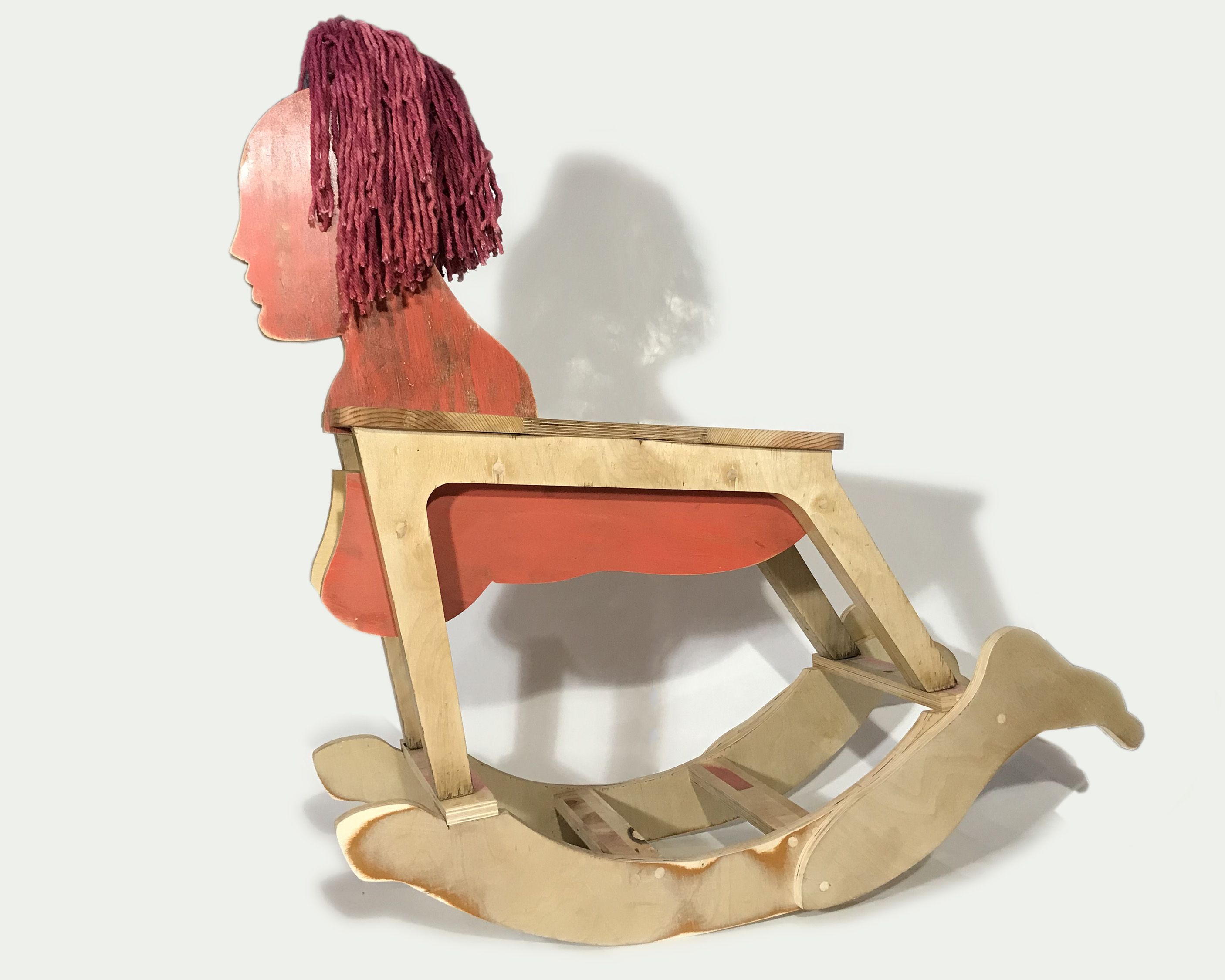
Child Care Worker- Self Portrait Rocking Toy

Where is your studio, and what is your primary work area?

Since 2015, I’ve been based at Fortress Studios, an artist-owned space in Detroit’s North End neighborhood. Initially, I came as an artist-in-residence for a year, but I never left.

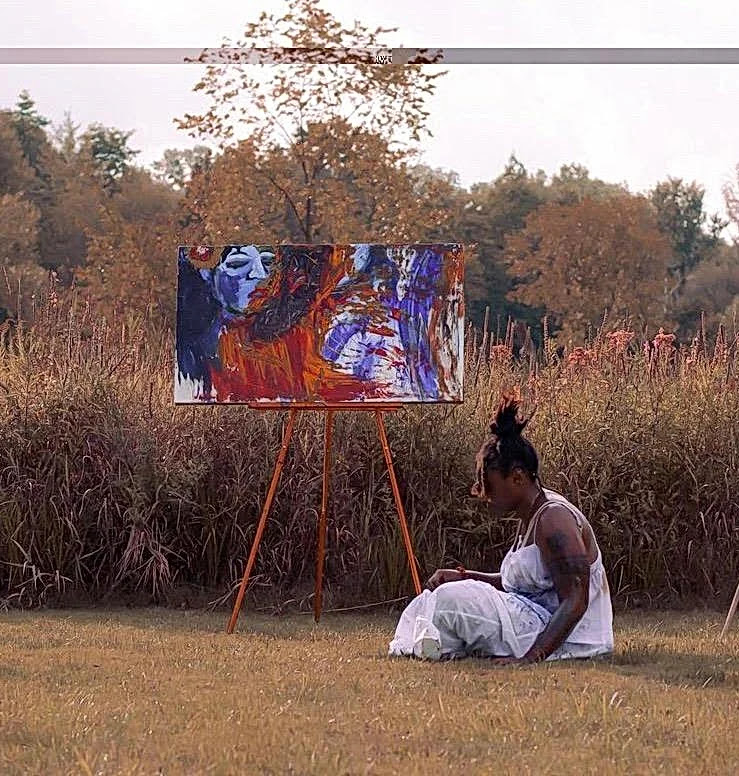
We’re fortunate to have a metal shop, wood shop, and ceramics studio in the building, which I use as needed. However, my primary workspace is a fibers studio that I’ve set up in a section of my living space. It’s filled with racks of second-hand fabrics and yarns, and it houses my sewing machine and loom. I’m also known to take over our kitchen for basket-making, felting, or botanical dyeing. As I write this in the summer, much of my work has moved to the patio, where I can spread out to weave baskets or set up a small easel to paint watercolors in the open air.

"I use common materials and familiar forms, hoping to make my art accessible to a broad audience, not just those with an art background." - Elise

What clues or questions do you use to select an idea to invest time and resources?

I have a lot of ideas, and my practice can sometimes feel a bit scattered. However, certain nagging ideas will keep resurfacing, or something happens that reminds me of a previously conceived concept. Sometimes, clarity on a concept comes months or even years later, and that’s when I decide to pursue it.

Let Me Comfort You- Photo Story

About your work: what do you hope people notice the most?

I think the themes of my work—empathy, comfort, and care—are universal, so I strive to avoid intellectual barriers. I use common materials and familiar forms, hoping to make my art accessible to a broad audience, not just those with an art background. While it would be impossible to speak to everyone’s lived experience or account for all cultural differences, I try to use a visual language that will be approachable to others.  

How do you define success as a creative? How do you hold yourself accountable?

I focus less on the notion of being a “successful artist” and more on the success of individual projects. As a creative, I think you have to embrace the reality that many of your projects, proposals, and concepts might fail. The goal is then to appreciate the successes, learn from them and carry those lessons forward. As I mentioned before, much of my practice is deeply connected to relationships with others, so that naturally pushes me to keep sharing my work.

Tactile Memory No.1

When do you discuss things with your inner critic?

Constantly!

There was a meme that circulated years ago, and I think about it often. It said something like, “The Creative Process: 1. This is pretty good. 2. This is awesome! 3. This is tricky. 4. This sucks. I suck. 5. This might be okay. 6. This is awesome!”  I think that pretty aptly sums up just about every project I’ve ever worked on.

Who are your creative influences, and whose work are you admiring now?

As a child, my first “favorite artists” were Georgia O’Keeffe and Van Gogh; I think I enjoyed their use of color. In my teen years, I was more influenced by the dramatic gestures on punk album covers and the rebellious spirit of illustrators like Ralph Steadman. As an adult, I’m drawn to quieter, more subtle moments of weirdness. Artists like Louise Bourgeois, Kiki Smith, Hans Bellmer, Mike Kelley, and Janine Antoni have greatly influenced my sculptural and installation work. In terms of craft, I look to alot of art history and anthropology for inspiration, but I have a particular fondness for fiber artists linked to (or with lineage out of) the Bauhaus School, such as Gunta Stölzl, Anni Albers, and Ruth Asawa.

Tactile Memory No. 4

How can people follow you and your work?

You can find me at EliseMarieMartin.com or on Instagram at @Elise.m.art.in. The next opportunity to see my work in person will be at the opening of Womxn House Detroit 2024 on September 28th.

##

I can't thank you enough for taking time out of your schedule to talk with me/us, Elise. I'm cheering for you! Come back anytime you have something to share. 


+++++++++++++++++++++++++++++++++++++


Use Me - Small Arrangement View


Use Me Interaction 1


Monday, November 18, 2024

Y1 E13 Tia Nichols - Forward Thinking

 Tia Nichols

The artist: Tia Nichols
All images are courtesy of the artist


My name is Tia Nichols and was born in Newport News, Virginia, raised abroad, and now based in Detroit. I consider myself an afro futurist, interdisciplinary artist exploring experience, memories, and dreams through surreal landscapes incorporating female figures.

~~~~~~~~~~~~~~~~

What do you love about making art?

Art for me is an escape. Not to claim myself as an escapist, but art provides a means to augment reality and travel distances into new and alternative realities. Making art offers moments of solace and remedy to the mundane of life, feeding my passion for life, encouraging me to persevere. Making art gives me a sense of purpose, giving me the freedom to express myself unapologetically. It is therapy. 

Which mediums do you like working with the most? What are some of the more unusual ones you've used in the past?

As an interdisciplinary artist I find myself performing alchemy and introducing a plethora of media into my work. I enjoy working with intaglio methods of printmaking such as etching and engraving on and into metals like zinc, copper, and aluminum. The most unusual medium I have worked with is tobacco. I created a series of work called "Formidable Formaldehyde" that focused on the inevitable state of climate change and how fumes are constantly emitted externally, but a major contributor to the deterioration of the internal body is smoking. Tobacco is of the nicotiana plant that is made up of nicotine, the addictive chemical that gets one hooked on cigarettes, cigars, or vapes. Tobacco is also used medicinally and for ceremonial purposes such as to relieve constipation or bring one closer to the ancestors through ingestion or inhaling. Tobacco has a long history of being grown in my Powhatan family in Kentucky since the 1910's. Like many plants, tobacco is interesting to look at, but maybe not so extraordinary. I have used Canadian and Virginian fluke to develop paper, sculptures, and mixed media works on paper just because of my quirky fascination with the substance. I figured I'd take something often misused and abused and turn it into something beautiful. 

How do you evaluate your work?

When in academic, collective, or cooperative settings, I evaluate my work through the lens of others. I ask for feedback, honest critique, and critical analysis of my work to encourage and solicit growth or reassurance. When alone in my studio, my room, or outside in the backyard I evaluate my work starting in this odd way of first walking away from the work then returning with my eyes closed. I then open my eyes really quickly and whatever major components stick out to me first I think to myself why am I drawn to these areas first? What caught my eye? Is this good? Is it just the color? Is it the level of detail? After I've jotted down some notes on those things that stood out to me more immediately I assess the rest of the composition in relation to those moments in my work. I consider the works of contemporary, master artists and whether or not I am creating in a relevant way or relative to those in the field and community. In the end, I evaluate my work and its success based on my level of interest in the work. If I am not interested in or excited by the work, it doesn't necessarily make it bad art or reduced art, but ultimately it isn't something I am proud of and would want presented. That brings up another point, does all art have to created for exhibition and display?


Where is your studio, and what is your primary work area?

I currently do not have a studio. My work area now is in a sunroom/living room where I sit on the couch and prop a canvas or drawing board up on my lap. Maybe not the most idealized space, but it allows me to get the job done.

What is your favorite guilty pleasure?

My favorite guilty pleasure is mixing paint directly on the canvas and not using a palette.

"Take some time to sit with why you're frustrated, jot down some notes on what is bothersome. --- Are these things solvable? Forward thinking is key."  


How do you define success as a creative? How do you hold yourself accountable?

The answer to this question is ever changing for me. At first I thought my success was reliant on the number of works I produced. Then I assumed the number of exhibitions and pop up shows was successful. Then I figured the number of solo shows I got meant more success as a creative. Then I thought the number of works I sold made me more successful. Now, I have found myself with a full ouvre of artwork that is unsold, waiting for turns in the rotation for the next art happening or call for art. It has gotten to the point where I give away work. I think now my success is gauged by my level of making and wanting to be a creative. I believed I was going to be a full time artist and that has not seemed to play itself out. So instead I am driven by learning discipline and maintaining momentum to hold myself accountable. 

When do you discuss things with your inner critic?

When staring at images of my work on my phone or laptop, when submitting for a new call for art or invitation to exhibit, when working through monumental applications for grants or fellowships, when my work is up on the wall. 

What advice do you have about throwing away work?

Great question. I think I will always experience a palpable feeling in my stomach when work is thrown out. The question that should be asked before looking to discard one's work of any form is why? If you find yourself boarded up in the house drowning by a mountain of work then I understand, but if you're throwing away the work just because you don't "like it", maybe reconsider how you define what is good or bad. Maybe redefine who your audience is and who is the reason you are creating for. Are you making for you? Or are you making for validation? Are you throwing the piece away out of frustration? If so, is there something you can do to improve it and make that one tweak to the composition or layer that would set it off in the right direction?

What advice can you share for artists who want to sell their work {online}?

Be consistent. Marketing management and SEO data analytics is important. Consider yourself as your number one fan and brand ambassador. With consistency you can and have to demonstrate why your product stands out from others. A legible website often helps to make this a possibility, but there are third party sources like etsy or even square point of sale that may work. But then again, I am not too versed in the successes of selling work online. I often use social media as a platform to publicly share work that will often get an inquiry for a completed sale. 


What would you tell other artists when they get frustrated with a project?

Step away for a second, get some fresh air, go for a walk, watch a new tv show, listen to your favorite song, take a nap, make some food, or all of the above. Sometimes a break and returning with a fresh eye and mind goes a long way. Take some time to sit with why you're frustrated, jot down some notes on what is bothersome. Are these things solvable? Forward thinking is key.  

Who are your creative influences, and whose work are you admiring now?

Mickalene Thomas, Kara Walker, Kerry James Marshall, Sam Gilliam, Judy Chicago, Frida Kahlo, Diego Rivera, Salvador Dali, Sydney James, Tylonn Sawyer, Peter Paul Rubens, Jean Du Buffet. There is no one at the moment that I can look into too much to say I admire right now, but that will change. 

How can people follow you and your work?

Website: www.moemoeproco.com

Instagram: @moemoeproductions 


Thank you for spending some time with me/us, Tia. I appreciate your generosity in chatting today. This has been such a fun conversation!  Know that you have an open invitation to return whenever you have something to share with the ChC audience!


Monday, October 21, 2024

Y1 E11 Martine MacDonald: Feed the Soul

 Martine MacDonald

Lark Becomes Bat, oil on board, 16 x 16;
All imagery is courtesy of the artist.


I’m Martine MacDonald, born a Mid-Century Modern in Motown. My current paintings concentrate on the figure, often using myself, family, and friends as models. The work is not to be seen in the context of portraiture, instead, I strive to capture universal themes found in the real and spiritual world of women.
 
I also work in 3-D mixed media, drawing, and occasional printmaking and the book arts. In 1999, I earned a Master of Arts in Studio Art from Wayne State University. Currently, I serve as adjunct faculty at Wayne County Community College.
 
~~~~~~~~~~~~~~~~~~~~~~~~~~
 

  What do you love about making art?

Martine MacDonald
It’s about the beautiful struggle, and the act of using physical materials, and with skill, work, and a modicum of talent, transforming the unformed idea into the tangible. What’s not to love?
 

How do you evaluate your work?

I ask questions: Does the finished work match my intention? Is this the best I can produce at this stage in my artistic development? 
 

Where is your studio, and what is your primary work area?

I maintain a studio as part of Fishnet Artist Studios, a collective of 7 artists located at 4357 Schaefer, Dearborn, MI. And like many artists who have a “public” studio, I also work in my smaller studio at home. 
 
I typically work on paintings on my favorite easel, given to me as a birthday gift from my husband some 20 years ago. Other times I work on a table in the studio or sometimes even in the dining room.
 

"The inward successes—a job well done,
a mastery of tools and techniques—
feed the soul.
I prefer first feeding the soul."

What clues or questions do you use to select an idea to invest time and resources?

I trust my intuition and the gentle persistent voice and insistent vision that says an idea must be made manifest.

The Golden Child, mixed media
 

About your work: what do you hope people notice the most?

I hope the image captures the viewer’s attention, which is then followed by a desire for people to come closer for a more intimate look.
 

What is your favorite guilty pleasure?

Oh, if I told you that I would be revealing my deep, dark secrets. And for that you must wait for my best-selling-tell-all-memoir. Okay, it might involve chocolates, foreign mysteries, and Netflix.
 

How do you define success as a creative? How do you hold yourself accountable?

The outward successes—the awards and money—feed the ego. The inward successes—a job well done, a mastery of tools and techniques—feed the soul. I prefer first feeding the soul.
 
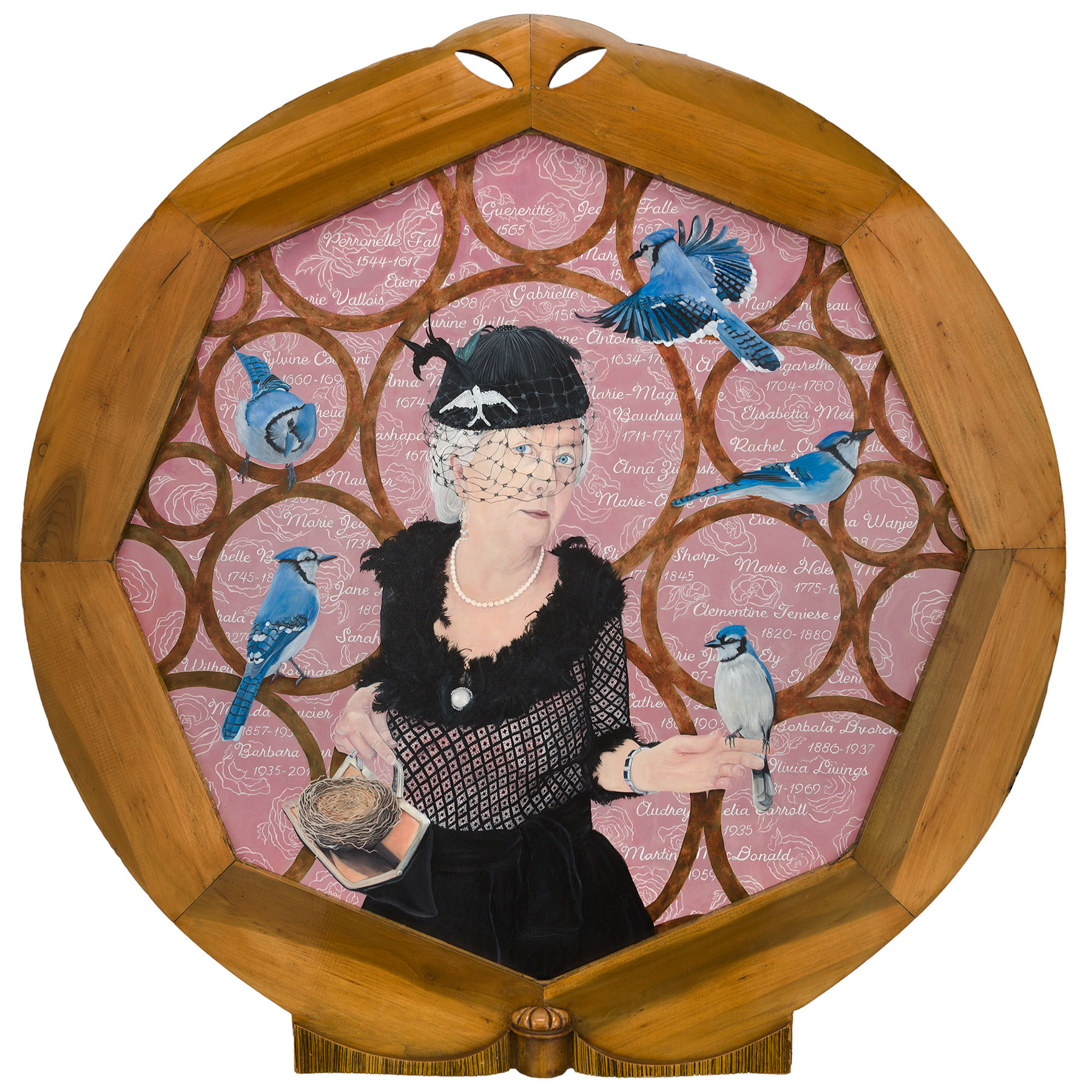
The Matriarchs, oil on board, 47 inches

What advice do you have about throwing away work?

The truth is you can’t save everything, unless you plan on making an immense museum to yourself. Save and date the pieces that show your progress and milestones on the journey, or hold great significance for you. For other work, consider altering or pirating parts of them to produce something that might spark a new creative pathway.  
 

How can people follow you and your work?

Instagram: @martimacart 

What would you like people to know that I haven't asked?

Two inspirational quotes: 
 
      To be like Michelangelo who said at age 86:

“Ancora imparo!” Still I am learning!
 

      And to be like the great Hokusai who said:

“When I am eighty, I shall have developed still further, and I will really master the secrets of art at ninety. When I reach a hundred my work will be truly sublime and my final goal will be attained around the age of one hundred and ten, when every line and dot I draw will be imbued with life.”


I can't thank you enough for taking time out of your schedule to talk with me/us. Please come back whenever you have something to share with the ChC audience!


Monday, August 26, 2024

Y1 E7 - Ephemera Fae: Spirit & Space-making

Meeting Ephemera, 2021. All images and videos are courtesy of the artist.

Hello, I’m Ephemera Fae. 

I am an interdisciplinary social practice artist. I enjoy space-making practices. Creating murals, and events, transforming places where people exist to help facilitate engagement with each other, and other conceptual goals defined by a community's needs. I also have a solitary practice that involves mixed media painting and illustration as well as digital design, video, and poetry. 

Ephemera Fae
I am a Detroit-based artist in love with that reality. I was born and raised in metro Detroit. It took leaving Michigan for about 10 years and returning to see Michigan and Detroit and connect to these different spaces authentically. 

It’s hard to determine what my favorite subject is. I used to identify as a portrait artist and in some ways, I tackle every project the way a portrait artist delves into creating a portrait. Connecting, translating, rendering, etc. However, portraits are not my favorite in the strictest sense anymore. I prefer to engage with the community and create from those engagements. I use surveys frequently to aid that process. So far that has not yielded much portraiture due to circumstance. 


~~~~~~~~~~~~~~~~~~~~~~~~

What do you love about making art?

I love the surprise of it all. Thinking I was making something one way like a smooth rendered portrait or that a survey would reveal a certain thing, or a sound piece was going to become a short cacophony only to end up a highly textured piece that was much more engaging than I originally anticipated.

Which mediums do you like working with the most? What are some of the more unusual ones you've used?

I love making murals. I love transforming space. I love working in groups. Because of circumstances I mostly use surveys, digital tools, markers, and water-based inks and paints. Partly this is because of limited studio space and working toward large projects. I have put together more proposals and applications than actual finished pieces since graduating 2 years ago. 

My main personal project is a spiritual space-making project. An oracle deck that is still in a color technique experiment phase so I am sort of using everything my space will let me right now. 

What do you love about that?

I am being forced to operate conceptually without manifestation a lot of the time. I am also forced to deal with all the elements of my artistic practice I once avoided and I’m getting rather good at that. I’m no longer intimidated by writing proposals. I now have base documents to build functional branding and starters to jump from for most requirements for applications. I’ve also been hammering out details like project charters and my own quote processes which are extremely boring but crucial for long-term success, especially for large projects.  

I love incorporating much of how I physically worked before going to graduate school. I lived in my sketchbook and had a rich mixed-media practice that incorporated drawing, painting, and collage. I was always doing it. By necessity, that's coming back to me now through this project, and I truly appreciate it. I tried to repair my sketch practice multiple times after my head injury but it was so overwhelming to keep up with the demands of grad school that I never rebuilt that skill. Now I am having to stretch some of those elements out and it is freeing in many ways.  


How do you evaluate your work?

I ask myself many questions. What is it giving to others? Who is a stakeholder and what might they see? Have I technically done what I can to serve the work? I ask the materials, as the piece is developing, what they are adding, doing, and needing. Each piece is constant communication which is why I often end up in a different place than I originally envisioned. I can't predict how every variable will communicate during the process, and I certainly can't control everything. While in the piece I am evaluating for authentically adhering to the process. When I am nearing completion, I am evaluating for effectively communicating the purpose(s) and looking for accidental missteps or errors that could cause harm. 

Where is your studio, and what is your primary work area?

My studio is in my home, which does not leave much space for large works. My primary work area is moving with me right now. I keep my small project in a transportable bag, I have a large sketchbook and my iPad ready on the go so I can take my temporal portions of my studio nearly anywhere. 

What clues or questions do you use to select an idea to invest time and resources?

2021 Mural Montage
Does it matter to me enough to keep me invested when it gets hard? Because it will get hard and no one going to make me do anything I better love the idea enough, be compelled enough, and be enthralled enough to grind through the parts I want to walk away from. I also have to consider if it will emotionally affect me too much. I have cataplexy and essentially go into sleep paralysis while I’m awake when I get emotionally overwhelmed or certain types of emotions come up inside me. I have to work with this awareness all the time. For instance, I am for a free Palestine and feel called to make work about being a queer person longing to fight for liberation and against colonial imperialism. However, when I start, I get overwhelmed and cataplexy kicks in and I haven’t found a way around that particular hump yet. So it’s a balance.  

I like to have a culture of completion with my work. Meaning I like to finish what I start. However, experiments teach me things and I am ok walking away from something when I’ve recognized that a particular project is taking more than it’s giving. It is not a viable project for that reason. Even calls for art can be like that. We will start working on something, but our process is involved and multilayered. If the hosts of the call for art have not provided certain types of information or the timeline is too crunched we might have to chalk it up to learning experiments because the project was ultimately not viable. 

"Art making is a matter of experiencing the work while also creating and
that can make a strange echo chamber."

About your work: what do you hope people notice the most?

Themselves and the people around them. I want them to feel something different about themselves or feel connected to others in a way that's new enough to get them to pause for a moment and have an experience they are present for. We’re frequently only partially tuned into our experiences and communities. It would be most excellent if the things I’ve been a part of making brought people into themselves, their spaces, and their communities. 

Details of Street Installation (Detroit, MI)

What is your favorite guilty pleasure?

It changes, but right now, I'm binge-streaming Star Trek the Next Generation on Prime. I can draw and sketch while watching, and something is very comforting about it. I used to watch the show as a kid, but it's very different in some ways as an adult. Honestly, sometimes it's like therapy, but more fun.


How do you define success as creative? How do you hold yourself accountable?

Success as a creative has to be defined personally. The teacher in me is specifying that my answer is for me, and about me. If what I have made is honest, authentic, and connective, and I did not turn away from the hard answers in the making, then it is a success. I have a lot of success sitting around my house. There's a big success outside of the Wayne State School of Medicine that was almost, by this definition, not. We hit some problems by not having connected to certain communities. There were many reasons for that but what was most important was this lack of connection had caused harm. People tend not to realize how powerful art is but it can break through barriers or raise them up with one look. Our hands-on leadership team had to take a hard stance with the project administrators to address this harm and come with humility to the impacted communities. Which happened in a different way again after it was installed with another community! Murals are wild. We sat in the community again and addressed these new sets of concerns and repaired the harm through changes to the mural after installation. Only then was it a success to me even though the administration had celebrated it as a success for months at that point.  


From "The Real Detroit, 2022" mural (Detroit, MI)
Article about mural + Documentary

When do you discuss things with your inner critic?

When it won't shut the fuck up. Just joking that's when I walk away from the piece because I have something else eating at me. When my critic can stay in their lane and be reasonable. If my inner voice is using value-based words then it's just imposter syndrome, confidence issues, or trauma taking the wheel, not my highly skilled inside artist who wants the best for each piece I make. I learned when I was very young if I’m not extremely careful about recognizing when my trauma is guiding that inner voice, I might just put an amazing work up in flames and regret it later.

What advice do you have about throwing away work?

Hmmmm. That's tough. It’s a balance that I take really seriously. If it’s a piece I am definitely not in conversation with anymore and I feel really does not have a crucial place to be in the world it's easy to part with. Like all things, it's a cost-benefit analysis but the benefit goes beyond what I think for myself usually. Of course, my lack of space trumps the best-laid plans some days. 


What advice can you share for artists who want to sell their work {online}?

Be diligent and consistent. Come up with the framework for how you’ll describe your work and use it as a template, so you have to make fewer decisions with each piece. Also, use the ALT Image descriptions. Accessibility is important. If you're selling work online consider it a business and keep your clients with disabilities in mind just like any physical business would need to. 

What would you tell other artists when they get frustrated with a project?

I don’t tell them much, but I ask them things like: Do you need to take a break? Would you like some water or to go for a walk? Would you like to tell me about your problem? I'd love to hear about it. Most artists work through their own art problem well by vocalizing it to another artist or someone they can collaborate with but the times they’ve genuinely needed direct input are few. Usually just questions for clarification of my own understanding illuminate things for the artist. Art making is a matter of experiencing the work while also creating and that can make a strange echo chamber. Having someone help you step outside of that for a little bit is crucial. 

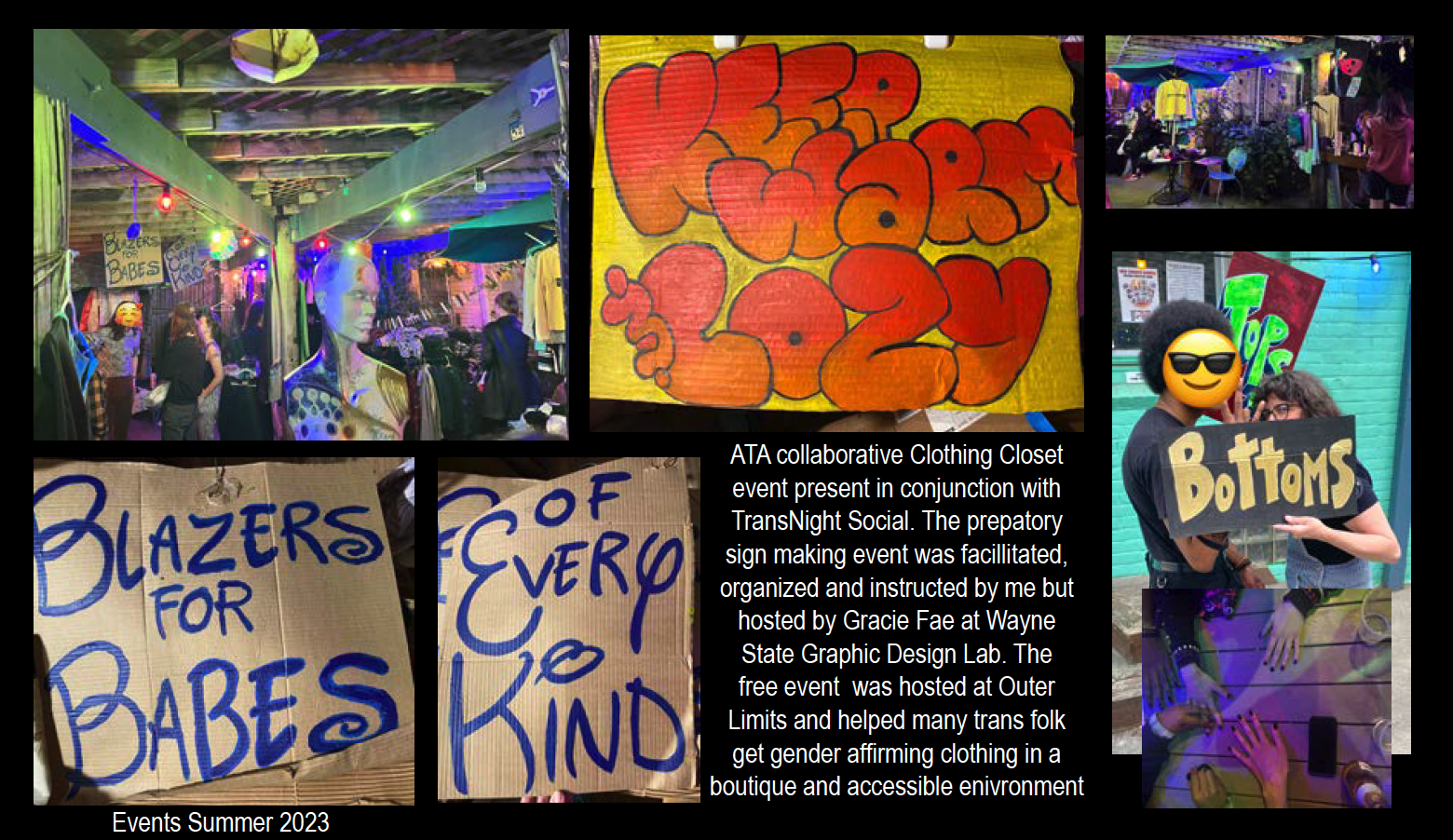
ATA Collaborative Clothing Closet Event, 2023


Who are your creative influences, and whose work are you admiring now?

Lorna Simpson, Chitra Ganesh, Tyree Guyton, and John Feodorov are some of the creatives who've influenced me. Recently I admire Sydney James' work as well as the amazing digital pieces and murals coming out of the resistance to the genocides being conducted by imperial powers particularly the Israeli genociding the Palestinian people. So many murals and digital works that I see pop up on Instagram showing the power of art to bring people together across great distances and disparate cultures. It’s truly beautiful.

How can people follow you and your work?

That's trickier than it should be. @ephemerafae on Instagram, Tiktok, and Patreon. My posting schedule has been inconsistent on social media since I started my Patreon. I am finding that balance. Having my focus be folks who give me money has created a temporary social media vacuum. 

What would you like people to know that I haven't asked?

--What kind of projects am I looking forward to making in the future?

More social practice murals. My application for the City Walls Abatement Residency is strong this year. I’m hoping to use it to find a home for the Interactive Hands mural that is still in storage at Wayne State. The residency will allow me to hold surveys with community members and work this process from start to finish multiple times. It will be strange to do it without my cohort member Cara Young. She'll be involved for finding a home for Interactive Hands but not the other murals. The residency can result in up to 5 murals throughout the city. 

Thank you for spending some time with us, Ephemera. The work is powerful; this has been fun. Please come back whenever you have something to share with the CHC audience!


Monday, July 1, 2024

Y1 E3: Robert Larocco: Maker, Teacher, Coach


Astrid
All images are courtesy of the artist.

Robert Larocco 

I am a 2D artist using many mediums, such as painting, digital illustrations, chalk pastels, and colored pencils, and even developing methods to help others create art. I am from the Detroit, MI, area and have lived in many different parts of the US over the last few years. I’m an academic advisor at the Stamps School of Art & Design (University of Michigan).

Rob Larocco


What do you love about making art?

What I love about making art has changed a lot over the years.  When I was in college, I loved what I was learning about various mediums and their associated media and processes.  I'm a curious person, so learning in general has always been a passion of mine, and being able to learn about and through something I love—creating art—was especially fulfilling.  As a high school art teacher, my love of making art shifted to the ways that I could teach others, especially young people, about how to both create and appreciate art for themselves.  Currently, as an adult who has finally returned to art education after several years working outside of that realm, my love for making art has changed once again.  Now, when I have the time, and I'm in the right mindset for creating art, I find that I enjoy the feeling of nostalgia that I get from returning to a practice that was such a huge part of my life for so long but that over the years I drifted away from.


How do you evaluate your work?

Honestly, I'm happy with any piece that I've actually finished!  I tend to get sidetracked and step away from projects for long periods of time.  When life settles down, oftentimes during the winter months, I return to projects that I've started.  So I guess my answer is, I'm happy with a piece or even a project that I've actually finished, regardless (mostly) of the quality. 


Where is your studio, and what is your primary work area?

I've lived in apartments since I was 18, so I've rarely had the square footage or room for an actual studio space.  I've made my kitchen table, a cleared space in a living room, and, on rare occasions, a spare bedroom my "studio."  My studio is really wherever I can find space to create. :).

What clues or questions do you use to select an idea to invest time and resources?

Much of the work that I've done over the past 4-5 years has been at the request of others, or it's been part of a functional DIY upgrade to something in my home/apartment, like repainting old picture frames.  When it comes to my own work, I tend to utilize subjects that our close and important to me, like pictures of my husband or our dog, Astrid.  Ideation has always been hard for me without having sort of a purpose or prompt to guide me.  It's one of the reasons I enjoyed teaching art, which is because although it's difficult for me to develop concepts or themes for my work, I do enjoy helping others find ways of unlocking or accessing their own creativity by exploring topics, themes, or subjects that are important to them or that they are especially curious about exploring through art.

About your work: what do you hope people notice the most?

Honestly, I'm not sure.  When I create something for someone else, such as the album artwork I did for a musician friend, I hope of course hope that they like it and also that they appreciate the time and thought that went into the creation of the piece(s).  I suppose I hope that people can see my own work, whether a specific piece of art or an upgrade to a functional home accessory, like a picture frame, and appreciate the time that went into it and also appreciate that maybe it's something they would like to try themselves.  


"...if someone truly wants to learn to create art, then they can" 

What is your favorite guilty pleasure?

I really have so many! haha. When it comes to art, I think my favorite guilty pleasure is comic books/comic book art, which I don't actually feel guilty about.  From a very young age I've had a fascination and appreciation for comic book artists.  I love the human form as a subject, and I'm especially attracted to the escapism that the stories in comic books and the science fiction and fantasy genre provide.  I used to love drawing superheroes and was inspired by artists like Alex Ross, Salvador Larocca, and Rob Liefeld.  


How do you define success as a creative? How do you hold yourself accountable?

For me, success as a creative is finding ways to express my creativity in as many aspects of my personal and professional life as possible.  It's usually so hard for me to make time to create "art", mainly I think because I let life and my own procrastination get in the way.  Also, I'm pretty happy with my life and my work, and I think a big reason for that is because I've had to find ways to channel my creativity into areas that are not necessarily related to creating art.  When I left teaching, I found creative outlets in my work in higher education through the development of digital newsletters and flyers, which really brought in elements of design that I hadn't really utilized as a teacher because I primarily focused on fine art mediums, such as drawing, painting, ceramics and the like.  Long story short, even though I'm not actively creating artwork on a regular basis, I do still feel that I am a creative person and I've found success.  


What advice do you have about throwing away work? 

Oh boy, well I've kept two big portfolios of my work from college and from teaching, so...  I can be very sentimental when it comes to things that connect me to my past, like pieces of my own that I created in college and even demos from my years teaching.  It's really hard for me to give those things up because it would mean discarding an important part of myself that I just want to hold onto.  I also feel like I have a terrible memory, and forgetting important things from my past is a little scary to me.  For those who live to create though, I can see the value or the cathartic aspect of throwing away work they aren't happy with or that is representative of someone they feel they no longer are. For me, I like to hold on to certain things, but ultimately, I think we all have to do what makes us happy.


How can people follow you and your work?

Honestly, the best way is to ask me about it.  I have social media accounts, but because I'm not a very active creator of art, I don't post often.  I do go through little spurts of artistic creativity, so if one of those comes along and some artwork is born from that, then I'll share it with others.  


What would you like people to know that I haven't asked?

Zentangle
This isn't really about me, directly, but it's more of a philosophy of mine.  I really believe that anyone can create art and create "good" art at that.  I think a lot of people who don't think of themselves as creative or artistic give up on themselves before they even try.  I've had students who thought they couldn't create "good" art because they viewed themselves as very math, science, or engineering-focused, but once I was able to help them to consider the ways that art can and does intersect with other disciplines, and help them to understand that everyone can learn to be more observant, they often find that they can turn their "technical" minds and skills toward art and create some amazing work.  In short, if someone truly wants to learn to create art, then they can. 


Thank you for spending some time with me, Rob. This has been such a pleasure! Please come back whenever you have something to share with the ChC audience.


Saturday, June 1, 2024

Y1 E2: Me, myself & I


I figured I had better be willing to answer some questions and get this party started.

Robin Jourdan's work explores how we relate to place. Placeness is how we connect to our environment, both real and imagined. This can include the (s)hero's journey, charting new courses, and translating natural phenomena into the visual and sensory. She uses handmade paper and mixed media to sculpturally explore the intersections of nature, science, and universal experience.  The results of her work may initially appear light-hearted but, with time and attention, reveal deeper themes of subtle energy, power structures, and the voice of materials. Her work reflects a belief that all life has a place here and a stake in what we do next.

Pinecone Nebula (rjourdan)

Which materials do you like working with the most? What are some of the more unusual materials you've used to create?
Currently, I enjoy working with fibers, especially handmade paper fibers. Sometimes, they turn into paper; sometimes, something else but the same material. I like that they’re amenable to working with other mediums and can support a story, especially when involving place. There are other media that I have enjoyed working with, but this is my current fav. I like that it doesn’t require specialized equipment beyond the beater.

I can use the fibers in a myriad of ways, which is enticing and compelling. Without additives, however, they can be fragile. But I don’t expect my work to last thousands of years, although paper can last thousands of years, as archeologists are finding. That's pretty bonkers.

Some of the more unusual materials might not be so unusual to someone else. I’ve embedded zebra mussels in the paper pulp.

What do I love about fibers, digital art, and animations?
These are individual and, perhaps, one day, the work will be fluid across them. Fibers: I can feel them while I work with them. Additionally, ease of access, including additional content, texture, and pigmenting/dyeing, is relatively easy and non-toxic.

How do you evaluate your work?
One of the first things I look for is how the loud conversation supports the concept, balance, and harmony of elements, materials, and compositions that support the concept. Loud conversation? When the piece figuratively calls to you from across the room. 

At a certain point, either I or the piece will smile. Sometimes the piece is too busy, that’s a problem I have quite often. So, then, I have to find the discipline to whittle out the unnecessary bits. That includes color and texture. Often, my intuition will offer additional suggestions that contribute to the concept, or at least contribute to a concept, an idea of sorts.

Where is your studio, and what is your primary work area?
My studio is in my house, which is most of my house. It’s comfortable and easily accessible, and most importantly, it doesn’t cost more money. This is important because I am not selling work. This way, I don’t really have to bear too much of a weight on that. I can work at all times of the day or night.

I can reflect on different pieces while in the process, recycle old pieces, and keep my materials handy and ready.

What clues or questions do you use to select an idea to invest time and resources?
I have a series of questions that I would ask myself, like: can I get enough material from the topic to make a body of interesting work. I'd need to develop a list of at least 8-10 ideas, not that all of them would make it into the studio. Then, I read about Laurie Anderson's 5 questions for art. She asks herself, is it:

  1. Complicated enough
  2. Simple enough
  3. Beautiful enough
  4. Crazy enough
  5. Stupid enough

I find this a super interesting list of questions I'm trying to adopt. Maybe she means the same as my initial list, but her list is much more poetic, light-hearted, and has an ease about it.

About your work: what do you hope people notice the most?
I hope they notice how the work makes them feel and perhaps think about how they respond to the work. Does it call to them? Do they want to spend a little time with the work? Then, if they're interested, it's cool if they dive into my intentions, the concept, the story. After that, if they notice the details of the making, colors, textures, or something perhaps special, that's a bonus.

I put a lot of energy into symbolism and other material and physical aspects of the works, but maybe that is more for me to learn about the concept and the ideas. I also put energy into balance and harmony, and what some call the loud conversation. That's like, if you're at a party and you see someone or something across the room, its appearance is such that you need a closer look. It compels, it intrigues, you want to know more. I learned this point of view from another artist, and I find it so helpful.

What is your favorite guilty pleasure?
This changes quite often, but currently, it's a few things: tiramisu cake, "Rick and Morty" (the animated series), and, oh, yeah, the Bee Gees' harmonies.

How do you define success as a creative? How do you hold yourself accountable?
I’ve thought about this for a while. The easy-answer success for many is sales. But, since art is a requirement for the artist only, that may not be the healthiest metric for me. So, I think for me, it needs to be something I have agency and control over. And I do not have control over sales. But I do have control over how much time I devote to making. That includes thinking, reflecting, writing, and researching, but mostly hand-to-material making. It’s a real luxury to be able to have some say in that and have it measured out at whatever bar I set for it. Am I reaching my goal? And there are moments when I realize an "aha" by another person that I think: I wish I had connected those bits myself. But we all feed the cycle, eh.

How I hold myself accountable is in the volume of work produced. Actually finished per the given time frame. That means perhaps finished work is further timed than hours of production, but they coincide, right? You’re not going to get finished work without putting in the time. And carelessly putting in the time isn’t going to guarantee finished work. Early on, I learned from a little story: a ceramics teacher took their class of students and split them into 2 groups. To the first group, they said that this group would be graded on making the finest vessels possible. To the second group, they said that this group would be graded on the volume of pieces made. When the semester ended, the group that had been graded on the volume of pieces outperformed the other group by a lot. The moral of the storymake a lot!

I also count the number of events that I enter. That’s also a bigger part of what I want to consider. I’m doing this to say something. No one is listening without getting the work out of the house. I have heard from enough people that getting into events is a numbers game. Much like having a good idea means you have a lot of ideas, the more events you enter, the greater your chance for success. I can't control how the work will be received, but I can have some say in how many events I enter.

Will you ever discuss things with your inner critic?
I started to say “all the time,” but then I stopped to ponder that. LOL… inner critic. I think I have an inner critic council or inner critic counsel. The critic council used to tell me how unworthy and un-everything-good the work was. Now, our conversations are less brutal and personal and more focused on how to reach a goal.

The "Angry Angies"* have been replaced by "Supportive Sarah's"*, and the group is more counsel than council.

*not real people.

What advice do you have about throwing away work?
This definitely depends on the situation. I try not to treat any of the work as precious, but I don’t want to waste materials either. So, if something can be recycled, I’ll let it hang back and rest until it’s time to drop back in. But if it’s hung around without contributing for too long, then its story needs to go somewhere, not here.

I’m learning new techniques to “upscale” and otherwise reuse the bits that aren’t working or whatever so I don’t have to landfill them. I really want to avoid that as long as possible. And that’s one of the excellent qualities of fibers—except for color, the base material can be renovated in many ways.

What advice can you share for artists who want to sell their work {online}?
Well, I’m learning this bit myself. I know it’s often a “numbers game,” so you have to take a lot of it with a grain of salt. It’s not personal, and it’s not about you as much as it might feel like it is. There is an art and science to selling, and it’s probably best to invest time and energy into it if it’s important to you.

What would you tell other artists when they get frustrated with a project?
Take a break and breathe. Don’t be afraid to pause. Maybe the project wants you to veer, and you must listen to that impulse.  Sometimes, it’s that break of 10 minutes or perhaps more that allows you to accommodate your inner change. Albert Einstein famously said that we can’t find solutions to problems with the same thinking we used to create them. Thus, it is important to think fresh at times. We all have deadlines, so it can be challenging to press pause, but necessary. It may be that you need to grow a little more so you can come back to the project as a slightly different person.

Who are your creative influences, and whose work are you admiring now?

I am spellbound by the work of Myungjin Kim, land artist Jon Foreman, Agnes Pelton, Hilma af Klimt, Nicole Donnelly, Hannah Vogel, Galen Gibson-Cornell, Jenn Omaitz, and Joel Abouzit. Alternately, Mark Knofler, J.J. Cale,  Khruangbin, Los Lonely Boys, and Stevie Ray Vaughn.


How can people follow you and your work?
By going to www.robinjourdan.com
I'm also on Instagram: @jourdan.studios

Dear Reader, this one is for you: Who do you think I should interview next? Why? Can you introduce us?
Thank you. I appreciate you reading this far! 


Y1 E1: Trailer 1 Creatives having Coffee


Seed of an Idea (rjourdan)

This could be called Robin talking with cool people. 

Many, if not all, of the cool people I hope to talk to are creative, and so this is a glimpse into their thinking about what they create.

I'll do my best to publish 2x/ month. 

I started this blog as a reaction to how difficult it can be for artists to put themselves and their work into the world. I realized there might be a gap, so I would take some steps to fill it, promote, and support some genuinely amazing artists. I also really enjoy talking with creative people about their work. How the "art" is made is fascinating to many of us. I hope this serves as a peek behind the curtain. We are all creative.

For more about me: https://creativeshavingcoffee.blogspot.com/2024/06/y1-e2-me-myself-i.htm

The Nuts & Bolts: