Favorite Quotes

==> Purpose: to inspire and uplift, encouraging readers to recognize their own creative potential through the stories of others. As John Cleese said: "Creativity is not a talent. It is a way of operating.”
Showing posts with label painting. Show all posts

Tuesday, March 25, 2025

E27 - Kathy Cornwell - Elements of Design & Cookies Too 0325

 Kathy Cornwell

After the Rain. All images are courtesy of the artist


Kathy Cornwell is a printmaker and mixed media collage artist based in Northern Virginia.  An enthusiastic daily hiker and world traveler, Cornwell has a deep sensitivity for the beauty of nature (from the large and majestic to the small and overlooked). Her work blends tactile experience, memory, awe, and angst.
~~~~~~~~~~~~~~~~~~~~~~~~~~~~~~~~~~~~~~
Kathy Cornwell

Kathy - it's great to have you here. Let's jump in!


What do you love about making art?

Art is one of the most powerful ways I know to get in touch with my deepest self and to affirm myself. There are times when I make a piece of art and afterward I look at it and wonder how I made it, and marvel that I created it. It's a great feeling! Other times, I struggle mightily while making a piece of art, and it's very satisfying to solve those problems (eventually!). Art builds my self confidence. 

Which mediums do you like working with the most? What are some of the more unusual ones you've used?

I wanted to be an artist ever since I was young, but it took decades to find the right medium (and the right mindset, if I'm being totally honest). For several years in my 20s, I learned to blow glass. I dabbled in quilting, rug hooking, embroidery, sewing, painting, and many other mediums, but it was a Goldilocks-like experience: nothing was "just right."

It wasn't until I tried monotype printmaking on a gel plate when I was 50 years old that I found a medium that was "just right." This medium is a wonderful fit for my nature: it is forgiving, fun, and flexible. It's easy on the body and can be done by pretty much anyone and just about anywhere. In fact, I recently taught my 90-something-year-old parents-in-law to gel print, and they are now enthusiastic printmakers!

Gelatin printmaking allows me to use all sorts of found materials. I love printing with plants and trash, especially discarded plastic wrap. I can also create my own stencils and masks to make my prints express my artistic voice even more explicitly.

I also have fallen more and more in love with working with cutting machines over the past few years. At first, my intention was to use the cutting machine for cutting stencils and masks for printmaking—and this is still a big part of it. But machine cutting has now become a big part of my collage practice.
Hello Helicopter


What do you love about that?

The things I love most about both gel printing and machine cutting are the element of delightful surprise and the notion of redemption. When I'm gel printing, I have a general idea of how a print layer will look based on experience, but because I work fast and intuitively, I leave room for surprise. Most of the time, I'm excited or intrigued by the results. And if it turns out to be a not-so-delightful surprise? I can always print another layer on top of it later and redeem it. In fact, some of my best prints came about in this way!

Machine cutting is all about delightful surprises for me. I find that cutting a monotype into a smaller, interesting shape is transformative. Even if the monotype is what I'd consider unattractive as a whole, a tiny shape made from it can be remarkably attractive. This is another way that prints are redeemed.

I should add that collage is another redemptive process: there are scraps of printed or painted paper that may not seem attractive on their own, but they may be perfect in a collage.
No Boys Upstairs


How do you evaluate your work?

I try to keep the elements of design in mind as I create my work, as much as I can. I think that these can provide guardrails to keep me from going off the road. I also check in with myself throughout the entire creation process: am I thinking too much about how the work will be received? Am I getting overindulgent and not considering them at all? I try to strike a balance.

Where is your studio, and what is your primary work area?

My studio is in an empty bedroom in my home, and to be honest, my work activities sometimes spill out into other areas of our home. Thankfully, my husband is very supportive and patient about that! In my studio, there is a standing desk that I use for printmaking, a 6-foot folding table that I use for collage work, framing, and other hands-on art tasks, a computer desk, and a large Cricut cutting machine on a wheeled stand. I have a tall stand full of bakery trays that can be used for drying smaller prints as well as for storing flat items, and I have a drying tray for prints that are a bit larger. I have bookshelves and boxes full of supplies, as well as a closet that is full of everything from shipping materials to frames. My studio is not the most tidy and photo-worthy space, but it works for me!

What clues or questions do you use to select an idea to invest time and resources?

This can be tricky! Artists need to explore paths and then change their minds, but you don't want to feel like a squirrel darting this way and that in the road, unable to make up your mind which way to go. I get excited by an idea and then I try it by making a few pieces. Usually this is enough to show me the challenges that are involved and the level of excitement that I have. If I'm still feeling excited as hell, I'll keep going! If the excitement is waning or it isn't meeting my expectations, I may shelve that idea for later.

"The most important measure of success is creating work ...and constantly improving. I hope that I'll continue making art and growing as an artist for the rest of my life!" - Kathy

About your work: what do you hope people notice the most?

I strive to make my work have graphic impact from a distance but fascinating detail up close. I hope that people will get lost in the layers and details of my work, seeing something new each time. For my collage work, I hope they feel a sense of joy when they discover a tiny shaped collage piece, like a kid finding an Easter egg.

What is your favorite guilty pleasure? ;-)

Eating cookies and candy in the studio. Every day.  
Friday Focus


How do you define success as a creative? How do you hold yourself accountable?

The most important measure of success is creating work (not just thinking about it or planning it) and constantly improving. I hope that I'll continue making art and growing as an artist for the rest of my life!

I hold myself accountable by setting goals yearly and monthly and then reviewing them at the end of each month. This shows me where I've been avoiding "scary" tasks or slacking off. I've worked with a coach for several years and having regular check ins with her has also helped me stay accountable.

When do you discuss things with your inner critic?

I notice that my inner critic speaks up a lot when I'm looking at the work of others, such as when I'm scrolling on Instagram. Feelings of admiration and envy can turn into inner critic whisperings about my own work or career prospects. When I'm looking at my own work, I find that my own thoughts (be they positive or critical) are completely unreliable in regard to how others feel. For example, I can fall in love with an artwork and the public response is crickets, while another piece that I don't feel so strongly about will turn out to be a fan favorite. As they say, we are terrible at reading the minds of others, so if my inner critic tries to tell me how my work stacks up or how it will be received, why should I bother listening to that?

What advice do you have about throwing away work?

I rarely throw any work away. The beauty of my art practice is that just about anything can be reused! I can cut up a monotype or collage and use it in a new collage, or print over it, or run it through the cutting machine and make collage fodder out of it. A collage on panel can be collaged over, or in the worst case scenario it could be sanded down and started over from scratch. My advice about throwing away work is the same as it is about throwing away trash: reuse and recycle as much as possible!

What advice can you share for artists who want to sell their work {online}?

I don't sell my work online. I'm only interested in selling my work through galleries and exhibitions, to be honest. This is because I'd like to put most of my effort into what I enjoy most: making the art. If I also undertake selling art online, there are a host of marketing and sales tasks that I'd have to do. That's not my zone of genius, but it is for galleries. I'm grateful to be working with a terrific gallery here in the Washington, DC, area called Broadway Gallery, and soon I hope to be represented at some other quality galleries.

What would you tell other artists when they get frustrated with a project?

Take a walk, take a shower, and sleep on it! Stepping away is often exactly what the doctor ordered. You'll return to your project with fresh eyes and new ideas.
Denim Dreams


Who are your creative influences, and whose work are you admiring now?

I've learned so much from Jane Davies and Julie Fei-Fan Balzer. They've had a huge impact on my art and development as an artist. Currently I'm admiring the work of Anne Marie Fischer and fiber artist Susan Lapham.

How can people follow you and your work?

I'd love your readers to connect with me on Instagram or Facebook @kathy.cornwell.art and to follow my journey by joining my newsletter at my website www.KathyCornwell.com


Kathy - Thanks so much for joining us/me today. I'm loving your work, and signed up for your newsletter! Come back and share any announcements with the CHC gang anytime!



Wet Walk


Monday, November 18, 2024

Y1 E13 Tia Nichols - Forward Thinking

 Tia Nichols

The artist: Tia Nichols
All images are courtesy of the artist


My name is Tia Nichols and was born in Newport News, Virginia, raised abroad, and now based in Detroit. I consider myself an afro futurist, interdisciplinary artist exploring experience, memories, and dreams through surreal landscapes incorporating female figures.

~~~~~~~~~~~~~~~~

What do you love about making art?

Art for me is an escape. Not to claim myself as an escapist, but art provides a means to augment reality and travel distances into new and alternative realities. Making art offers moments of solace and remedy to the mundane of life, feeding my passion for life, encouraging me to persevere. Making art gives me a sense of purpose, giving me the freedom to express myself unapologetically. It is therapy. 

Which mediums do you like working with the most? What are some of the more unusual ones you've used in the past?

As an interdisciplinary artist I find myself performing alchemy and introducing a plethora of media into my work. I enjoy working with intaglio methods of printmaking such as etching and engraving on and into metals like zinc, copper, and aluminum. The most unusual medium I have worked with is tobacco. I created a series of work called "Formidable Formaldehyde" that focused on the inevitable state of climate change and how fumes are constantly emitted externally, but a major contributor to the deterioration of the internal body is smoking. Tobacco is of the nicotiana plant that is made up of nicotine, the addictive chemical that gets one hooked on cigarettes, cigars, or vapes. Tobacco is also used medicinally and for ceremonial purposes such as to relieve constipation or bring one closer to the ancestors through ingestion or inhaling. Tobacco has a long history of being grown in my Powhatan family in Kentucky since the 1910's. Like many plants, tobacco is interesting to look at, but maybe not so extraordinary. I have used Canadian and Virginian fluke to develop paper, sculptures, and mixed media works on paper just because of my quirky fascination with the substance. I figured I'd take something often misused and abused and turn it into something beautiful. 

How do you evaluate your work?

When in academic, collective, or cooperative settings, I evaluate my work through the lens of others. I ask for feedback, honest critique, and critical analysis of my work to encourage and solicit growth or reassurance. When alone in my studio, my room, or outside in the backyard I evaluate my work starting in this odd way of first walking away from the work then returning with my eyes closed. I then open my eyes really quickly and whatever major components stick out to me first I think to myself why am I drawn to these areas first? What caught my eye? Is this good? Is it just the color? Is it the level of detail? After I've jotted down some notes on those things that stood out to me more immediately I assess the rest of the composition in relation to those moments in my work. I consider the works of contemporary, master artists and whether or not I am creating in a relevant way or relative to those in the field and community. In the end, I evaluate my work and its success based on my level of interest in the work. If I am not interested in or excited by the work, it doesn't necessarily make it bad art or reduced art, but ultimately it isn't something I am proud of and would want presented. That brings up another point, does all art have to created for exhibition and display?


Where is your studio, and what is your primary work area?

I currently do not have a studio. My work area now is in a sunroom/living room where I sit on the couch and prop a canvas or drawing board up on my lap. Maybe not the most idealized space, but it allows me to get the job done.

What is your favorite guilty pleasure?

My favorite guilty pleasure is mixing paint directly on the canvas and not using a palette.

"Take some time to sit with why you're frustrated, jot down some notes on what is bothersome. --- Are these things solvable? Forward thinking is key."  


How do you define success as a creative? How do you hold yourself accountable?

The answer to this question is ever changing for me. At first I thought my success was reliant on the number of works I produced. Then I assumed the number of exhibitions and pop up shows was successful. Then I figured the number of solo shows I got meant more success as a creative. Then I thought the number of works I sold made me more successful. Now, I have found myself with a full ouvre of artwork that is unsold, waiting for turns in the rotation for the next art happening or call for art. It has gotten to the point where I give away work. I think now my success is gauged by my level of making and wanting to be a creative. I believed I was going to be a full time artist and that has not seemed to play itself out. So instead I am driven by learning discipline and maintaining momentum to hold myself accountable. 

When do you discuss things with your inner critic?

When staring at images of my work on my phone or laptop, when submitting for a new call for art or invitation to exhibit, when working through monumental applications for grants or fellowships, when my work is up on the wall. 

What advice do you have about throwing away work?

Great question. I think I will always experience a palpable feeling in my stomach when work is thrown out. The question that should be asked before looking to discard one's work of any form is why? If you find yourself boarded up in the house drowning by a mountain of work then I understand, but if you're throwing away the work just because you don't "like it", maybe reconsider how you define what is good or bad. Maybe redefine who your audience is and who is the reason you are creating for. Are you making for you? Or are you making for validation? Are you throwing the piece away out of frustration? If so, is there something you can do to improve it and make that one tweak to the composition or layer that would set it off in the right direction?

What advice can you share for artists who want to sell their work {online}?

Be consistent. Marketing management and SEO data analytics is important. Consider yourself as your number one fan and brand ambassador. With consistency you can and have to demonstrate why your product stands out from others. A legible website often helps to make this a possibility, but there are third party sources like etsy or even square point of sale that may work. But then again, I am not too versed in the successes of selling work online. I often use social media as a platform to publicly share work that will often get an inquiry for a completed sale. 


What would you tell other artists when they get frustrated with a project?

Step away for a second, get some fresh air, go for a walk, watch a new tv show, listen to your favorite song, take a nap, make some food, or all of the above. Sometimes a break and returning with a fresh eye and mind goes a long way. Take some time to sit with why you're frustrated, jot down some notes on what is bothersome. Are these things solvable? Forward thinking is key.  

Who are your creative influences, and whose work are you admiring now?

Mickalene Thomas, Kara Walker, Kerry James Marshall, Sam Gilliam, Judy Chicago, Frida Kahlo, Diego Rivera, Salvador Dali, Sydney James, Tylonn Sawyer, Peter Paul Rubens, Jean Du Buffet. There is no one at the moment that I can look into too much to say I admire right now, but that will change. 

How can people follow you and your work?

Website: www.moemoeproco.com

Instagram: @moemoeproductions 


Thank you for spending some time with me/us, Tia. I appreciate your generosity in chatting today. This has been such a fun conversation!  Know that you have an open invitation to return whenever you have something to share with the ChC audience!


Monday, October 21, 2024

Y1 E11 Martine MacDonald: Feed the Soul

 Martine MacDonald

Lark Becomes Bat, oil on board, 16 x 16;
All imagery is courtesy of the artist.


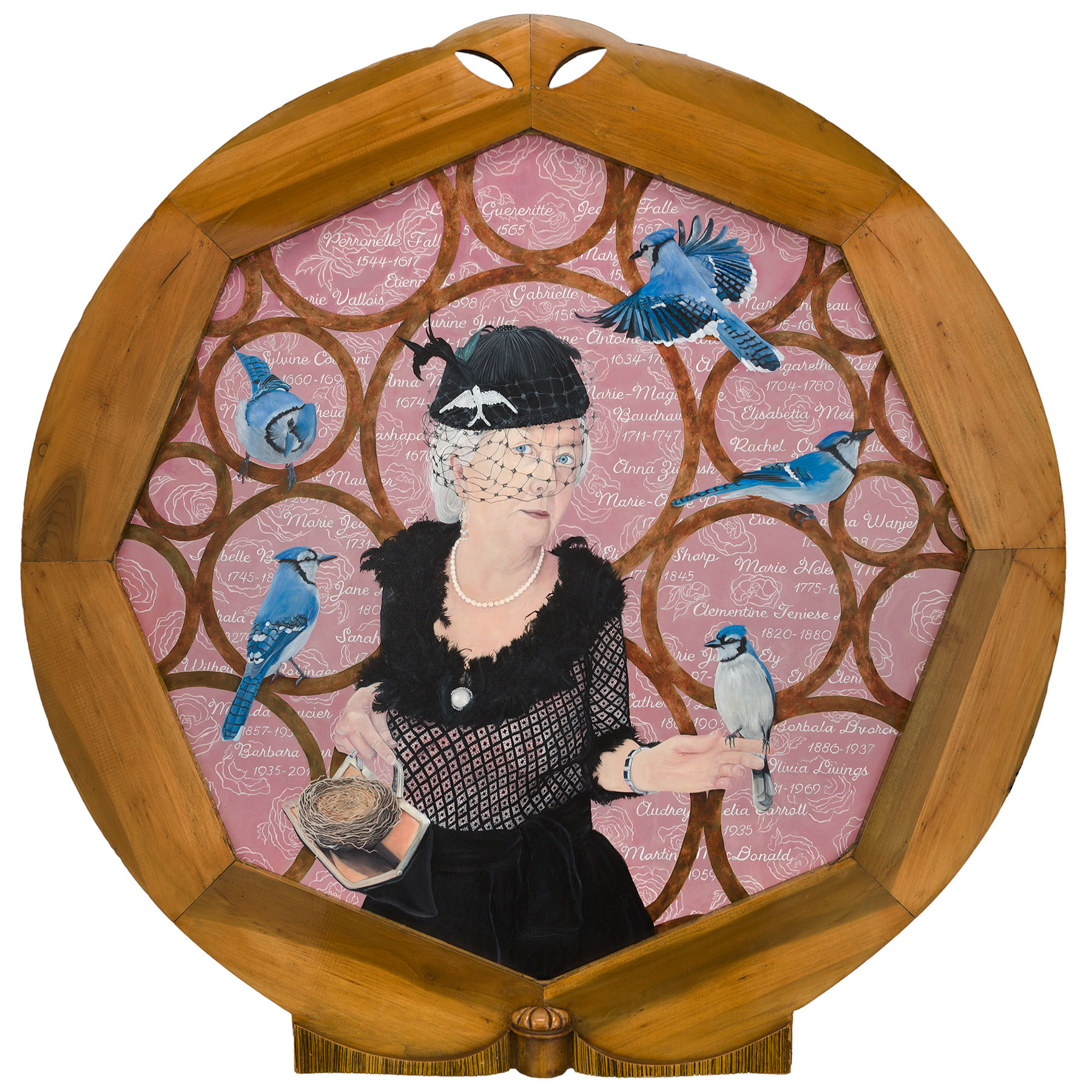
I’m Martine MacDonald, born a Mid-Century Modern in Motown. My current paintings concentrate on the figure, often using myself, family, and friends as models. The work is not to be seen in the context of portraiture, instead, I strive to capture universal themes found in the real and spiritual world of women.
 
I also work in 3-D mixed media, drawing, and occasional printmaking and the book arts. In 1999, I earned a Master of Arts in Studio Art from Wayne State University. Currently, I serve as adjunct faculty at Wayne County Community College.
 
~~~~~~~~~~~~~~~~~~~~~~~~~~
 

  What do you love about making art?

Martine MacDonald
It’s about the beautiful struggle, and the act of using physical materials, and with skill, work, and a modicum of talent, transforming the unformed idea into the tangible. What’s not to love?
 

How do you evaluate your work?

I ask questions: Does the finished work match my intention? Is this the best I can produce at this stage in my artistic development? 
 

Where is your studio, and what is your primary work area?

I maintain a studio as part of Fishnet Artist Studios, a collective of 7 artists located at 4357 Schaefer, Dearborn, MI. And like many artists who have a “public” studio, I also work in my smaller studio at home. 
 
I typically work on paintings on my favorite easel, given to me as a birthday gift from my husband some 20 years ago. Other times I work on a table in the studio or sometimes even in the dining room.
 

"The inward successes—a job well done,
a mastery of tools and techniques—
feed the soul.
I prefer first feeding the soul."

What clues or questions do you use to select an idea to invest time and resources?

I trust my intuition and the gentle persistent voice and insistent vision that says an idea must be made manifest.

The Golden Child, mixed media
 

About your work: what do you hope people notice the most?

I hope the image captures the viewer’s attention, which is then followed by a desire for people to come closer for a more intimate look.
 

What is your favorite guilty pleasure?

Oh, if I told you that I would be revealing my deep, dark secrets. And for that you must wait for my best-selling-tell-all-memoir. Okay, it might involve chocolates, foreign mysteries, and Netflix.
 

How do you define success as a creative? How do you hold yourself accountable?

The outward successes—the awards and money—feed the ego. The inward successes—a job well done, a mastery of tools and techniques—feed the soul. I prefer first feeding the soul.
 
The Matriarchs, oil on board, 47 inches

What advice do you have about throwing away work?

The truth is you can’t save everything, unless you plan on making an immense museum to yourself. Save and date the pieces that show your progress and milestones on the journey, or hold great significance for you. For other work, consider altering or pirating parts of them to produce something that might spark a new creative pathway.  
 

How can people follow you and your work?

Instagram: @martimacart 

What would you like people to know that I haven't asked?

Two inspirational quotes: 
 
      To be like Michelangelo who said at age 86:

“Ancora imparo!” Still I am learning!
 

      And to be like the great Hokusai who said:

“When I am eighty, I shall have developed still further, and I will really master the secrets of art at ninety. When I reach a hundred my work will be truly sublime and my final goal will be attained around the age of one hundred and ten, when every line and dot I draw will be imbued with life.”


I can't thank you enough for taking time out of your schedule to talk with me/us. Please come back whenever you have something to share with the ChC audience!


Monday, October 7, 2024

Y1 E10: Michael Brzozowski: Heart, Mind, and Spirit


Michael Brzozowski
All images are courtesy of the artist


Michael Brzozowski

My painting practice revolves around the relationship humans have within their natural surroundings. Pulling inspiration from my environment, I am drawn to the vast waterways of the Great Lake region. My work culminates my diligent sketchbook practice - a singular image of various concepts and notions.

I draw inspiration from water's boundless and reflective nature—the solace and tranquility I experience viewing out into Lake Huron's horizon. My deep-rooted connection to the land summons remembrance of my past, subjects that become prominent in my work.

Painting on a large scale immerses one in the imagery, pushing you into the natural world. Depicting ephemeral moments in the landscapes summons viewers to pause and examine the natural beauty that we inhabit.

Motivated by the social, cultural, and political issues of water, I work to unite the divide between human existence and our environment. The ingrained interconnectedness of humanity and nature is prominent within my practice and highlights the impermanence of not only our natural world but also of ourselves.

~~~~~~~~~~~~~~~~~

What do you love about making art?

I love the process of creating. Starting from nothing, developing an idea, and following it through to completion.


Which mediums do you like working with the most? What are some of the more
unusual ones you've used?

I like pen and ink in my sketchbook. I use acrylic paint in my painting practice and occasionally use found materials from the shores of lakes and rivers.

Manitou


What do you love about that?

I find adding found materials to my paintings adds a layer of interest.


How do you evaluate your work?

Finding alternative ways of seeing my work. And seeking out blind reads from other artists.


Where is your studio, and what is your primary work area?

Currently Old Main at Wayne State University in Detroit [MI].


"Art is a commitment and is not easy."


What clues or questions do you use to select an idea to invest time and resources?

I try to select ideas organically. As a visual artist, it all depends on what engages me visually.

Transformation

About your work: what do you hope people notice the most?

I want people to notice an aesthetic that draws you into the work.


What is your favorite guilty pleasure?

Being Lazy


How do you define success as a creative? 

I define success as a creative when you do everything in your will to advocate for your art and you let go of your ego.


When do you discuss things with your inner critic?

I think artists should have a habit of inner dialogue that talks and listens to their work.


What advice do you have about throwing away work?

Think of it as a memorial or a burial. Make it a ceremony.


What would you tell other artists when they get frustrated with a project?

Keep going. Be persistent. It is ok to be frustrated. Art is a commitment and is not easy.

Zug


Who are your creative influences, and whose work are you admiring now?

I like to think of animate and inanimate influences that are outside of human influence. Unfortunately, culture is built on the backs of other humans.


How can people follow you and your work?


What would you like people to know that I haven't asked?

Art involves inclusiveness that is dualistic. It requires active participation. Heart, Mind, and Spirit.


Thank you for spending some time with me, Michael. This has been such fun. Please come back whenever you have something to share with the ChC audience!