Favorite Quotes

==> Purpose: to inspire and uplift, encouraging readers to recognize their own creative potential through the stories of others. As John Cleese said: "Creativity is not a talent. It is a way of operating.”
Showing posts with label printmaking. Show all posts

Tuesday, March 25, 2025

E27 - Kathy Cornwell - Elements of Design & Cookies Too 0325

 Kathy Cornwell

After the Rain. All images are courtesy of the artist


Kathy Cornwell is a printmaker and mixed media collage artist based in Northern Virginia.  An enthusiastic daily hiker and world traveler, Cornwell has a deep sensitivity for the beauty of nature (from the large and majestic to the small and overlooked). Her work blends tactile experience, memory, awe, and angst.
~~~~~~~~~~~~~~~~~~~~~~~~~~~~~~~~~~~~~~
Kathy Cornwell

Kathy - it's great to have you here. Let's jump in!


What do you love about making art?

Art is one of the most powerful ways I know to get in touch with my deepest self and to affirm myself. There are times when I make a piece of art and afterward I look at it and wonder how I made it, and marvel that I created it. It's a great feeling! Other times, I struggle mightily while making a piece of art, and it's very satisfying to solve those problems (eventually!). Art builds my self confidence. 

Which mediums do you like working with the most? What are some of the more unusual ones you've used?

I wanted to be an artist ever since I was young, but it took decades to find the right medium (and the right mindset, if I'm being totally honest). For several years in my 20s, I learned to blow glass. I dabbled in quilting, rug hooking, embroidery, sewing, painting, and many other mediums, but it was a Goldilocks-like experience: nothing was "just right."

It wasn't until I tried monotype printmaking on a gel plate when I was 50 years old that I found a medium that was "just right." This medium is a wonderful fit for my nature: it is forgiving, fun, and flexible. It's easy on the body and can be done by pretty much anyone and just about anywhere. In fact, I recently taught my 90-something-year-old parents-in-law to gel print, and they are now enthusiastic printmakers!

Gelatin printmaking allows me to use all sorts of found materials. I love printing with plants and trash, especially discarded plastic wrap. I can also create my own stencils and masks to make my prints express my artistic voice even more explicitly.

I also have fallen more and more in love with working with cutting machines over the past few years. At first, my intention was to use the cutting machine for cutting stencils and masks for printmaking—and this is still a big part of it. But machine cutting has now become a big part of my collage practice.
Hello Helicopter


What do you love about that?

The things I love most about both gel printing and machine cutting are the element of delightful surprise and the notion of redemption. When I'm gel printing, I have a general idea of how a print layer will look based on experience, but because I work fast and intuitively, I leave room for surprise. Most of the time, I'm excited or intrigued by the results. And if it turns out to be a not-so-delightful surprise? I can always print another layer on top of it later and redeem it. In fact, some of my best prints came about in this way!

Machine cutting is all about delightful surprises for me. I find that cutting a monotype into a smaller, interesting shape is transformative. Even if the monotype is what I'd consider unattractive as a whole, a tiny shape made from it can be remarkably attractive. This is another way that prints are redeemed.

I should add that collage is another redemptive process: there are scraps of printed or painted paper that may not seem attractive on their own, but they may be perfect in a collage.
No Boys Upstairs


How do you evaluate your work?

I try to keep the elements of design in mind as I create my work, as much as I can. I think that these can provide guardrails to keep me from going off the road. I also check in with myself throughout the entire creation process: am I thinking too much about how the work will be received? Am I getting overindulgent and not considering them at all? I try to strike a balance.

Where is your studio, and what is your primary work area?

My studio is in an empty bedroom in my home, and to be honest, my work activities sometimes spill out into other areas of our home. Thankfully, my husband is very supportive and patient about that! In my studio, there is a standing desk that I use for printmaking, a 6-foot folding table that I use for collage work, framing, and other hands-on art tasks, a computer desk, and a large Cricut cutting machine on a wheeled stand. I have a tall stand full of bakery trays that can be used for drying smaller prints as well as for storing flat items, and I have a drying tray for prints that are a bit larger. I have bookshelves and boxes full of supplies, as well as a closet that is full of everything from shipping materials to frames. My studio is not the most tidy and photo-worthy space, but it works for me!

What clues or questions do you use to select an idea to invest time and resources?

This can be tricky! Artists need to explore paths and then change their minds, but you don't want to feel like a squirrel darting this way and that in the road, unable to make up your mind which way to go. I get excited by an idea and then I try it by making a few pieces. Usually this is enough to show me the challenges that are involved and the level of excitement that I have. If I'm still feeling excited as hell, I'll keep going! If the excitement is waning or it isn't meeting my expectations, I may shelve that idea for later.

"The most important measure of success is creating work ...and constantly improving. I hope that I'll continue making art and growing as an artist for the rest of my life!" - Kathy

About your work: what do you hope people notice the most?

I strive to make my work have graphic impact from a distance but fascinating detail up close. I hope that people will get lost in the layers and details of my work, seeing something new each time. For my collage work, I hope they feel a sense of joy when they discover a tiny shaped collage piece, like a kid finding an Easter egg.

What is your favorite guilty pleasure? ;-)

Eating cookies and candy in the studio. Every day.  
Friday Focus


How do you define success as a creative? How do you hold yourself accountable?

The most important measure of success is creating work (not just thinking about it or planning it) and constantly improving. I hope that I'll continue making art and growing as an artist for the rest of my life!

I hold myself accountable by setting goals yearly and monthly and then reviewing them at the end of each month. This shows me where I've been avoiding "scary" tasks or slacking off. I've worked with a coach for several years and having regular check ins with her has also helped me stay accountable.

When do you discuss things with your inner critic?

I notice that my inner critic speaks up a lot when I'm looking at the work of others, such as when I'm scrolling on Instagram. Feelings of admiration and envy can turn into inner critic whisperings about my own work or career prospects. When I'm looking at my own work, I find that my own thoughts (be they positive or critical) are completely unreliable in regard to how others feel. For example, I can fall in love with an artwork and the public response is crickets, while another piece that I don't feel so strongly about will turn out to be a fan favorite. As they say, we are terrible at reading the minds of others, so if my inner critic tries to tell me how my work stacks up or how it will be received, why should I bother listening to that?

What advice do you have about throwing away work?

I rarely throw any work away. The beauty of my art practice is that just about anything can be reused! I can cut up a monotype or collage and use it in a new collage, or print over it, or run it through the cutting machine and make collage fodder out of it. A collage on panel can be collaged over, or in the worst case scenario it could be sanded down and started over from scratch. My advice about throwing away work is the same as it is about throwing away trash: reuse and recycle as much as possible!

What advice can you share for artists who want to sell their work {online}?

I don't sell my work online. I'm only interested in selling my work through galleries and exhibitions, to be honest. This is because I'd like to put most of my effort into what I enjoy most: making the art. If I also undertake selling art online, there are a host of marketing and sales tasks that I'd have to do. That's not my zone of genius, but it is for galleries. I'm grateful to be working with a terrific gallery here in the Washington, DC, area called Broadway Gallery, and soon I hope to be represented at some other quality galleries.

What would you tell other artists when they get frustrated with a project?

Take a walk, take a shower, and sleep on it! Stepping away is often exactly what the doctor ordered. You'll return to your project with fresh eyes and new ideas.
Denim Dreams


Who are your creative influences, and whose work are you admiring now?

I've learned so much from Jane Davies and Julie Fei-Fan Balzer. They've had a huge impact on my art and development as an artist. Currently I'm admiring the work of Anne Marie Fischer and fiber artist Susan Lapham.

How can people follow you and your work?

I'd love your readers to connect with me on Instagram or Facebook @kathy.cornwell.art and to follow my journey by joining my newsletter at my website www.KathyCornwell.com


Kathy - Thanks so much for joining us/me today. I'm loving your work, and signed up for your newsletter! Come back and share any announcements with the CHC gang anytime!



Wet Walk


Monday, January 20, 2025

E19 - Susan Fecho - Appalacia, Vernacular, and "Slow Art"

 Susan Fecho

Susan Fecho, the artist. All images are courtesy of the artist.

My work interprets the past as a personal, cultural, and archetypal artifact. The human body, architectural unit, and surrounding landscape become metaphors in my work. Trained as a traditional printmaker, I am intrigued by the richness and variety inherent in varied techniques. Storytelling is at the core of my work, with the sculptural book as a mode of telling stories, expressing feelings, and sharing imagery. Through my work the familiar reappears in unfamiliar configurations; a new sense of significance is imparted to an otherwise everyday object. My creative interests extend beyond the viewed subject, encompassing sculptural elements, allegorical imagery, and whimsical puns. In my work, there are varied layers of material and multiple facets of meaning.

Susan Fecho, a Professor of Art at Barton College, has shown in 25 solo exhibitions and over a hundred invitationals. Fecho’s published images have been accepted into several major collections: the Smithsonian Institution’s American Art Museum/National Portrait Gallery Library, Washington, D.C.; the Word and Image Department, Victoria and Albert Museum, London, England; and the Museum of Women Artists, Washington, D.C. Fecho is a multi-media printmaker/surface designer with an earned M.F.A. from East Carolina University as well as postgraduate studies from various institutions including; Jan Van Eyck Academie, Humboldt Field Research Institute, Milwaukee Institute of Art and Design, Northern Illinois University and Penland School of Crafts. She has exhibited regionally, nationally and internationally – and has received numerous awards, grants and residencies.

~~~~~~~~~~~~~~~~~~~~~~~~~~~~~~~~~~~~~~`

Susan - I am so pleased to have this opportunity to talk with you about your art and process. Let's begin!

What do you love about making art?

On a personal level, the making of art satisfies an internal need, is meditative, and I love the “craft” of making. I have a “day job” to allow myself to produce art that heals or soothe my personal ethos - and my career as an art educator nurtures the personal desire to be a producing studio artist. Born of the Appalachians, My DNA provided a storytelling “need.” I just so enjoy conjuring up a narrative that interprets the vernacular into a new work of art series.  Since I like to wander-about as part of my vernacular research, I find myself noticing and seeing surroundings  - and am inspired to produce art that shares. During high school, I studied industrial technology, music and the visual arts; on the undergraduate level, I narrowed to industrial technology and the visual arts. I have narrowed down to what area was the most self-satisfying. I elected printmaking, botanical illustration and textiles. These involve craft, science, chemistry - and not watching the clock to see “how long it takes to complete a piece. 

Lichen

How do you evaluate your work?

I ponder and ponder during the art making process, research options, and run those pesky elements of art and principles of design through my head. Works in progress are reviewed to see if I managed to “stick-to-the-plan”  [a developed proposal concerning the series]. Did I incorporate my vernacular readings? Did I work in various mediums [for I am a collector of media and techniques] and did I incorporate what makes the work “my work.” And there are times, I am “finished” with a piece when I run out of time - there seems to always be something else that could be edited or added. 

Where is your studio, and what is your primary work area?

I have a small studio building in the historic district of Tarboro, NC. The building was designed to be a carriage repair shop in the late 1800s. This building has concrete floors to manage the weight of a couple of heavy vintage printmaking presses. There is storage space to organize supplies for various techniques. The space has tables, easels, cabinets and shelves. The enjoyable part of having a studio is that you can leave items out to dry, to layout in preparation, and leave out while in progress. 

What clues or questions do you use to select an idea to invest time and resources?

The notion of vernacular as a topic has helped tremendously across several decades to narrow down the subject. I do enjoy traveling, and will work on pieces related to place. But I tend to select subjects and themes related to the regions of NC and VA that nurture my “ideal” of ancestral and social landscapes; this includes the Appalachian mountains, central Piedmont plateau and the eastern Atlantic coastal plain. I am currently working on landscapes and table-top landscapes that include imagery of the region with the collected botanicals and natural specimens from the region. 

About your work: what do you hope people notice the most?

I would hope that people slow down and look closely at my work - to see the layers of material, to notice the unfamiliar configurations, the attention to details, etc. My work is a mixed media approach with an eye for up cycled materials. 

Series V

What is your favorite guilty pleasure?

Paper, handmade paper. When I travel, I rarely purchase souvenirs - unless it is paper made in that region. I am also a sucker for vintage fabric and lace to embed into my work. 

"I am more comfortable experimenting and stepping back to “discuss” the progression of the piece." - SF

How do you define success as a creative? How do you hold yourself accountable?

That is a a loaded question that depends on age and period of your artistic career - My friends and I do talk about how to define success as a creative if you do not exhibit or work on a commission basis. Created work - as a visual artist not creating site-specific installations that are dismantled at the end of a timeframe - has to be stored.  And how many pieces can we give away to family members?

That is why I do “slow art.” I prefer to develop pieces that are time consuming  - so that I do not run through materials. I do exhibit my work when possible in regional venues, but that requires having a quantity of framed inventory prepared to deliver - and then not in inventory until after the scheduled exhibition timeframe.

I like to consider success as a creative to involve productivity, and public sharing.  Sharing to an audience can vary - from print to digital publication, or through exhibition [of local, regional, national or international level]. I enjoy making a handmade season’s greeting card each year. It is satisfying for my creative soul and then shared on a personal basis. My memo - just keep making art and maybe others will see it and enjoy. 

"18"

When do you discuss things with your inner critic?

This seems to be an on-going discussion with my own inner critic. Being a studio artist is not the same as being a designer working for a client, an artist that works on commission, or a production artist producing for a commercial market. Studio work is a lonely creation space. Now that I am older, and with health concerns, the quiet hermit like environment of my studio is comforting. I am more comfortable experimenting and stepping back to “discuss” the progression of the piece. The inner critic does have to be concerned with making only successful art  - it is the journey and progression that is important. 

Who are your creative influences, and whose work are you admiring now?

My answer will not be direct. I teach graphic design, core studio courses and art history lectures - that means I review, study and present the works of an ever widening list of artists, designers and styles. That has taught me to have a broader lens of what to admire due to saturation level. When I visit galleries and museums, I try look at the work first and the name second, with a preference to view curated exhibitions of artists I might not know. Also, my parents and in-laws were international missionaries. Their travels introduced me to artists and craftsmen that are not shown in main stream museums. It is my preference to enjoy the difference. My home is filled with work from all over the world, and I love to trade a piece of my work with the creations of my fellow artists. 

How can people follow you and your work?

I can be located on instagram @fechodesigns. 

Botanical


What would you like people to know that I haven't asked?

I am an identical twin with a sister that is a research anatomist. I draw medical illustrations for her and her colleagues publications. That “secret” career has continued across decades. We started this as an academic excuse to see each other regularly, and travel together conferences. 


Susan, I can't thank you enough for taking time out of your schedule to talk with me/us. I always learn something! And I especially love the idea of "Slow Art"! Come back anytime you have something to share. 


Monday, December 2, 2024

Y1 E14: Jerry Smith - Hands, Prints, and Intersections

Jerry Smith

A Movable Feast -
All images are courtesy of the artist

Jerry Smith is a re-emerging artist who received his BFA in 1979 from Miami University with a concentration in painting and printmaking, and his MFA in 1981 from the University of Colorado focusing on painting and drawing. In addition to traditional mediums, Jerry’s early work consisted of life-sized, three-dimensional abstract figures made from torn and woven tar paper, paint, and roofing compounds on carved wood armatures.  After a 40-year career in nonprofit arts administration and fundraising, Jerry returned to working full-time as a visual artist in 2021 with a focus on figurative drawing and painting. More recently, he has re-engaged with his early interest in printmaking. Jerry draws on his lived experience with diverse performing and visual arts organizations and educational institutions to inform and heighten his creative work.  Jerry lives in Shaker Heights, OH with his wife Sue Starrett.


Hi Jerry Smith! I am thrilled to talk to you today. Let's jump in.

What do you love about making art? 

Jerry Smith
I'm an introvert; I love working alone. I love thinking visually, and I love working with my hands.  Sadly, I did not always prioritize my art, so there was a long period when I was not producing work of any importance. Since retiring  three years ago as a fundraiser for Case Western Reserve University, I’ve been focusing full-time (whatever that means) on painting, drawing, and printmaking. I’ve transitioned from making money to making art

Which mediums do you like working with the most? What are some of the more unusual ones you've used?

I think I am happiest with a big ol’ chunk of vine charcoal in my hand.  It may not be the most stable of mediums but it is deliciously fluid and expressive. It’s wonderful for exploring new ideas on paper. Beyond that, I enjoy mediums like oil or pastels that are fluid and easily manipulated.  Pen and ink?  Watercolor?  - not so much! The fastidious and process-oriented corner of my brain loves printmaking.

The most unusual material I have worked with is commercial roofing (tar) paper. I grabbed some scraps from a worksite dumpster in graduate school and then started buying it by the roll. I would tear, paint, and weave it over wooden armatures to create abstract figurative works. I keep one of those pieces at my studio door as an altar to the creative spirit. The throughline to my current exploration of fabrics and textures is apparent.

On your website, you call yourself a re-emerging artist. How different or the same does the art world feel to you now?

Oh golly, there was no World Wide Web in 1981. We moved at a slower pace. An artist visited studios, traveled to galleries, subscribed to magazines, and read books to follow the art world. Now, there are so many avenues to share your work and be exposed to other artists of interest. Spend an hour searching for artists who inspire you, and you’ll have a lifetime of images flooding your cellphone!  Perhaps it was the institutions where I studied, but no one taught me the “business of art.”  I am attempting to learn that on the fly now. 
Better Hand Made

How do you evaluate your work?

I suppose like many artists, I am my worst critic. I can see perfection with my mind’s eye but struggle to translate the idea to image.  It helps to get away from my work – put it in a drawer, turn the front to the wall or just leave the studio.  Sometimes I sneak a peek just before bed so I can ruminate on the work in my sleepless hours. Feedback from respected individuals is also important.  While I may not always agree with the assessment - positive or negative - it can break the loop in my brain and allow me to consider the work in a new light. Framing a piece or viewing it in a new environment is also instructive. 
Blue Dolly Dress

Where is your studio, and what is your primary work area?

I work primarily in the third-floor suite of our Shaker Heights home. Trust me, the space is getting ever smaller as my practice grows.  I long for more vertical wall space and room to work on multiple projects simultaneously.  But that said, the convenience of an in-home space has its advantages. I can spend long hours or grab short bursts of time to work.  I can take my cup of coffee or beer upstairs and just sit in the middle of the enviornment. I won’t talk about natural light.  We live in Cleveland; that changes by the hour!  And that’s why we have electricity. 

I also rent studio access at Zygote Press for printmaking.  It’s been a great way to encourage this introvert to meet and interact with other artists. I love the whole Zygote community including the staff, interns, visiting artists, and resident printmakers. 

What clues or questions do you use to select an idea to invest time and resources?

I am fully committed to exploring vintage children’s dresses and coats for a while longer. They are my haystacks and sunflowers.  They present endless and invigorating challenges for drawing, painting, and printmaking.  I hold the garments in my hands and I look for clues about how, by whom, and for whom they are made.  I look carefully for labels, seams, embellishments, or hand-sewn stitches. I find additional clues in the stains, the creases, and the deterioration of the fabric. Stories develop. The history of the garment and the life of the original owner (imagined or known) meld with my contemporary world in the resulting artwork. I am exploring ideas of identity, memory, loss, safety, comfort, and protection as I work through each piece.  New ideas flow from one to the other and are influenced by the people around me – and current events.  

About your work: what do you hope people notice the most?

I always want people to see the artist’s – Jerry’s” – hand.  I want them to notice what is unique about the work and what went into its creation.  I rarely work from memory or imagination. I want the subject in my view.  I sometimes use photography or other technologies to inform my work, but the end result is a response to what I am seeing that is created by my own hand and informed by all of my senses. Some marks are reflexive gestures, and others are meticulously crafted. My challenge is to find the balance. I hope that the work will evoke a visceral response that is informed by shared experiences of the artist and the viewer. That is success!  
Perilous Journey

What is your favorite guilty pleasure?

Oh, it’s probably bidding on vintage children’s dresses on Ebay.  It’s addictive.  Every time I buy something, there is a new item that appears that “I might like” (which I often do) or the seller offers me a deal (that I can’ refuse)! As new acquisitions fill my studio space, It looks  like I have turned the closet inside out.

How do you define success as a creative? How do you hold yourself accountable?

I am fortunate that I do not need to rely on my creative work to put a roof over my head or pay the bills. I do however want to maintain a professional practice as a creative, which means showing and selling my work. . Making art is not a retirement hobby, but a new career focus - one that I had imagined more than 40 years ago when I earned my MFA.  I am learning the business of art and building connections with individuals and institutions that can aid in that process.  Each year I set short and mid-range goals for my creative practice to measure success. Sadly, I am just too old for long-term goals!

"As a student of the 70’s the abstract expressionists – Willem DeKooning and Joan Mitchell in particular – were a major influence, but I also gravitated to figurative artists like Alice Neal, Eric Fischl, and Lucian Freud."    

When do you discuss things with your inner critic?

Oh that damned inner critic!  He never leaves me alone.  As my wife will confirm, I come out of the studio like Jekyl and Hyde.  I am either the most wonderfully inventive and creative artist of all time or a complete failure, depending on the day or the hour.  I talk to my critic constantly, but we have the really hard conversations just before I invest in framing costs or prepare for an exhibit. Sometimes I just tell him to shut up, and I move on. 

What advice do you have about throwing away work?

I try not to let my work become too precious in the making and to remain willing to erase or paint over even the really “good parts” if necessary or toss it aside. I would advise that artists not be too hasty to throw things away because looking back - even at the failures -  can be instructive. But there comes a time to “clean house.”  You need space in those flat files for new work, and you must ask yourself if you really want someone to find this when you are dead? Then it’s time to be brutal and head to the recycling center. 

What would you tell other artists when they get frustrated with a project?

Walk away if you can.  Do something else. Talk about the project with someone you trust. I am a big proponent of visual language standing on its own, but sometimes it helps to verbalize what you are thinking or trying to achieve.  Accept feedback, but only keep the advice that makes sense to you.

I've worked throughout my life with a number of performing art organizations. I remind myself that an actor, musician, or dancer has a specific and limited time as the curtain goes up and the house lights dim.  They rely on their training, preparation, and artistry to deliver their best performances. We visual artists have the luxury of time but then comes the moment when we need to put the work out there and start the next project. 
Refuge #3

Who are your creative influences, and whose work are you admiring now?

Perhaps no surprise that Jim Dine’s bathrobes are an inspiration for my work.  I had actually forgotten about these works until I was reminded, but I’m sure they were somewhere in the back of my mind when I started working on the dresses. As a student of the 70’s the abstract expressionists – Willem DeKooning and Joan Mitchell in particular – were a major influence, but I also gravitated to figurative artists like Alice Neal, Eric Fischl, and Lucian Freud.    

Here in Cleveland, I am a huge fan of Paula Damm for her amazingly inventive and topical works that incorporate a variety of crafts, of Leslie Discont Arian for her visceral and often wrenching abstractions, and of  Lisa M. Schonberg for her beautiful and evocative climate-focused prints and her generosity of spirit. 

How can people follow you and your work?

After several failed attempts on my own, I finally hired someone to create a website: 
I am developing a presence on Instagram @jerrysmith.artist

What are you working on currently?

Much of my time in recent months has been spent in preparation for a three-week artist residency at the Morgan Conservatory in September. I have proposed making paper as a substrate for my printmaking, and we’ll see where that exploration takes me. I have been attending workshops with the talented staff at the Morgan to learn Western and Eastern papermaking techniques, as well as exploring techniques of pulp painting. In the studio, I’ve been sketching woodblock print designs for the paper I’ll be creating and carving a number of blocks, which I’ve been testing on a plethora of handmade papers to understand the unique properties of various fibers.   

In the meantime, I continue to make drawings, and I’m working on  my first stone lithograph in 45 years.  I love drawing on stone - now we’ll see if I can remaster the etching and printing process. I’ve totally neglected my oil paints, but have been hearing the siren call. 

What would you like people to know that I haven't asked?

Recently I have been thinking about the intersections of my life and art. I grew up in Paulding, Ohio, a rural community of about 3,300 people in Northwestern Ohio.  Residents were by and large self-sufficient. We gardened, we canned, we tended to home repairs, and we made things - clothing, quilts, and crafts. We walked to work, school, church, and the homes of friends and family. We looked in on our neighbors and were ready to lend a hand when needed.  I left that childhood home after completing an undergraduate degree and moved away - geographically, politically, and spiritually. Now I am using my artistic practice to explore this schism.

My father was a typesetter at a small print shop his entire career. When I don my denim apron or smell printer’s ink, I think of him, and I wish he were around so we could ”talk shop.”  He did not agree with all of my life choices, but he steadfastly supported my journey as an artist, and would be pleased to see where that journey has taken me.

My mother was a teacher and encouraged my love of art from an early age. She engaged me to help create decorations and projects for her kindergarten classroom, and she found private instruction to supplement my school’s minimal art education program. She was a seamstress, a quilter, and a baker.

At an early age I learned to work with my hands from both parents. They taught me how to build things, repair things, grow things, and make things.  When I am not making art you might find me elaborately decorating cookies, baking bread, growing vegetables, or exploring color and texture in our flower gardens. 

I have no biological children, but after the death of my first wife twenty-three years ago, I remarried and gained two remarkable stepsons who have since married and started families of their own. Through my four grandsons I am observing how we humans find our place in the world and watching how innate creativity can develop – or be squashed.  In my workshop, they challenge me to create the impossible while I attempt to demonstrate that there is no limit to their creativity.  We laugh, we argue, and we make crazy things.  And then I steal away with that joy and wonder to my studio. 
Sue's First Day


Thank you so much, Jerry Smith. As a fellow printmaker, I think we may need a field trip to the print studio. Please feel free to come back and update us on your adventures anytime.


Monday, October 21, 2024

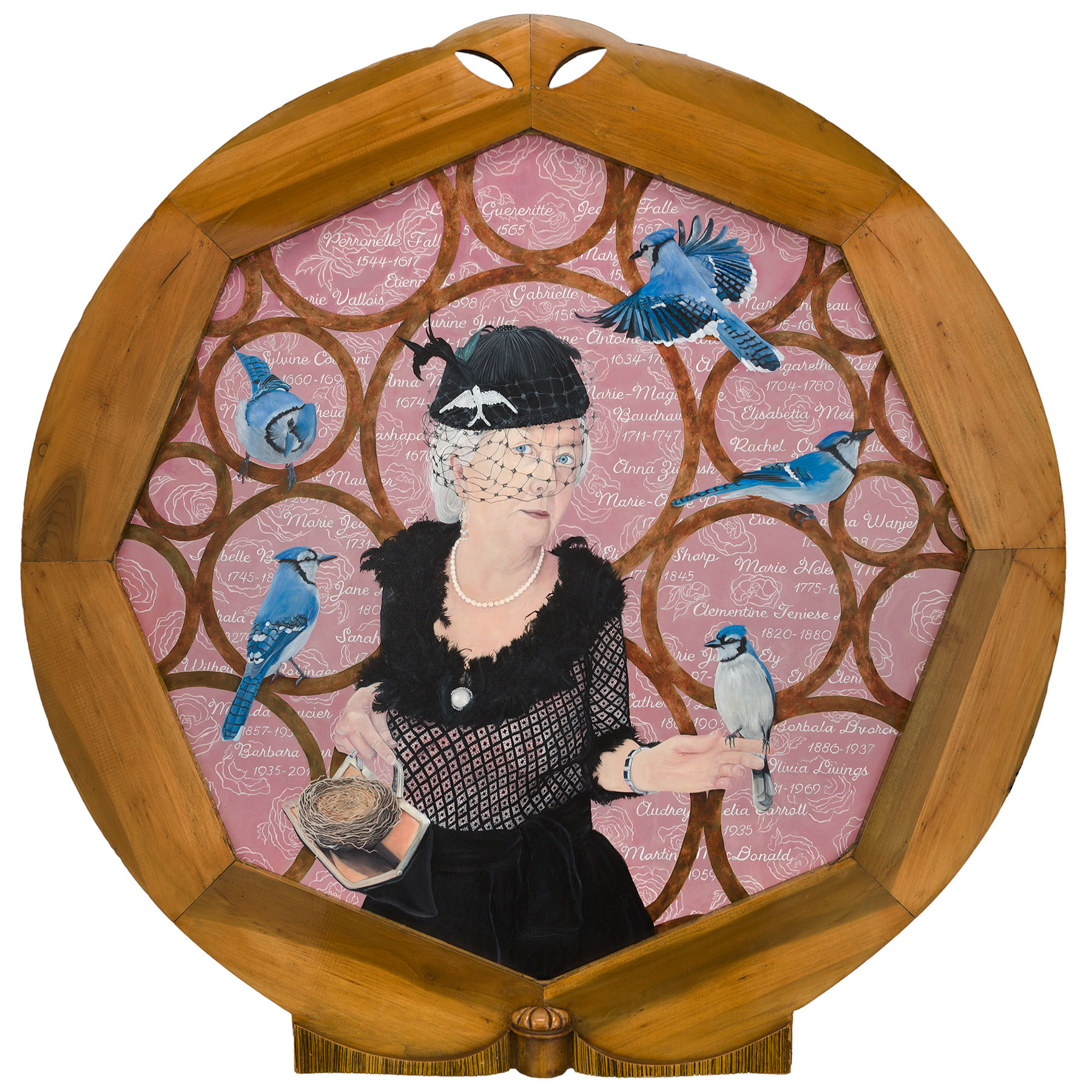
Y1 E11 Martine MacDonald: Feed the Soul

 Martine MacDonald

Lark Becomes Bat, oil on board, 16 x 16;
All imagery is courtesy of the artist.


I’m Martine MacDonald, born a Mid-Century Modern in Motown. My current paintings concentrate on the figure, often using myself, family, and friends as models. The work is not to be seen in the context of portraiture, instead, I strive to capture universal themes found in the real and spiritual world of women.
 
I also work in 3-D mixed media, drawing, and occasional printmaking and the book arts. In 1999, I earned a Master of Arts in Studio Art from Wayne State University. Currently, I serve as adjunct faculty at Wayne County Community College.
 
~~~~~~~~~~~~~~~~~~~~~~~~~~
 

  What do you love about making art?

Martine MacDonald
It’s about the beautiful struggle, and the act of using physical materials, and with skill, work, and a modicum of talent, transforming the unformed idea into the tangible. What’s not to love?
 

How do you evaluate your work?

I ask questions: Does the finished work match my intention? Is this the best I can produce at this stage in my artistic development? 
 

Where is your studio, and what is your primary work area?

I maintain a studio as part of Fishnet Artist Studios, a collective of 7 artists located at 4357 Schaefer, Dearborn, MI. And like many artists who have a “public” studio, I also work in my smaller studio at home. 
 
I typically work on paintings on my favorite easel, given to me as a birthday gift from my husband some 20 years ago. Other times I work on a table in the studio or sometimes even in the dining room.
 

"The inward successes—a job well done,
a mastery of tools and techniques—
feed the soul.
I prefer first feeding the soul."

What clues or questions do you use to select an idea to invest time and resources?

I trust my intuition and the gentle persistent voice and insistent vision that says an idea must be made manifest.

The Golden Child, mixed media
 

About your work: what do you hope people notice the most?

I hope the image captures the viewer’s attention, which is then followed by a desire for people to come closer for a more intimate look.
 

What is your favorite guilty pleasure?

Oh, if I told you that I would be revealing my deep, dark secrets. And for that you must wait for my best-selling-tell-all-memoir. Okay, it might involve chocolates, foreign mysteries, and Netflix.
 

How do you define success as a creative? How do you hold yourself accountable?

The outward successes—the awards and money—feed the ego. The inward successes—a job well done, a mastery of tools and techniques—feed the soul. I prefer first feeding the soul.
 
The Matriarchs, oil on board, 47 inches

What advice do you have about throwing away work?

The truth is you can’t save everything, unless you plan on making an immense museum to yourself. Save and date the pieces that show your progress and milestones on the journey, or hold great significance for you. For other work, consider altering or pirating parts of them to produce something that might spark a new creative pathway.  
 

How can people follow you and your work?

Instagram: @martimacart 

What would you like people to know that I haven't asked?

Two inspirational quotes: 
 
      To be like Michelangelo who said at age 86:

“Ancora imparo!” Still I am learning!
 

      And to be like the great Hokusai who said:

“When I am eighty, I shall have developed still further, and I will really master the secrets of art at ninety. When I reach a hundred my work will be truly sublime and my final goal will be attained around the age of one hundred and ten, when every line and dot I draw will be imbued with life.”


I can't thank you enough for taking time out of your schedule to talk with me/us. Please come back whenever you have something to share with the ChC audience!